Thailand and Malaysia are the two nomad visas I get asked about most, usually by founders who are also thinking about where to put a company. They look similar on paper. Both let you live in the country and work remotely for overseas clients. In practice they suit quite different people.
One thing up front. I set up and run companies in Malaysia and Hong Kong, but I don't handle visas in either country. So this is the view of someone who deals with the company and tax side and watches clients go through the visa side.
The quick version
Thailand's Destination Thailand Visa (DTV) is cheap, lasts five years and doesn't care much about your job title. It does want THB 500,000 in the bank and, since 31 August 2026, you generally have to apply from a country where you're a national or permanent resident.
Malaysia's DE Rantau Nomad Pass is shorter, up to two years in total, with an income test that depends on what you do. It's run by MDEC, the government's digital economy agency, and it's more paperwork. In return you get a clearly defined status and a government body you can actually email.
Thailand's DTV in plain terms
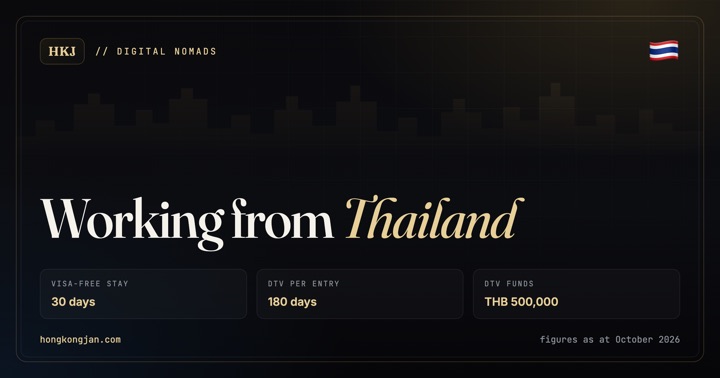
- Length. A five-year, multiple-entry visa. Each entry lets you stay up to 180 days, and each stay can be extended once by another 180 days at a Thai immigration office.
- Who qualifies. Remote workers, freelancers and digital nomads working for clients or employers outside Thailand. It also covers people doing "soft power" activities like Muay Thai or Thai cooking courses, plus spouses and children of holders.
- Money. Proof of at least THB 500,000 in funds. Some embassies want six months of bank statements, so check yours.
- Fee. THB 10,000, charged in local currency, so the exact amount varies by embassy.
- New since 31 August 2026. Proof of permanent residence where you apply, replacing the old proof of current location, and a criminal record certificate.
- The limit. It isn't a work permit. You can't work for Thai employers or take Thai clients.
That residence change matters for nomads. The old trick of applying from a neighbouring country's embassy mid-trip is largely gone. If you've no settled home anywhere, it's now harder to get.
Malaysia's DE Rantau Nomad Pass in plain terms
- Length. A Professional Visit Pass valid for 3 to 12 months, renewable for another 12, so 24 months maximum. Multiple entry.
- Income test. USD 24,000 a year for tech talent, such as developers, designers, data people and digital marketers. USD 60,000 a year for non-tech roles, including founders and CEOs, consultants, finance, legal, HR and sales.
- Proof. Contracts that started at least three months before you apply, plus three months of payslips or invoices and matching bank statements.
- Fees. MYR 1,080 per applicant and MYR 540 per dependant, both including 8% SST and non-refundable. Then an immigration pass fee of MYR 360 a year, and a refundable security bond of MYR 200 to 2,000 depending on nationality if MDEC acts as your sponsor.
- Family. Spouse or partner, children under 18 and parents can come as dependants. Your spouse can't work.
- Process. Apply online through MDEC, allow six to eight weeks, then endorse the pass on arrival with health insurance and a Malaysian tax registration slip.
- The limits. It covers Peninsular Malaysia and Labuan, not Sabah or Sarawak. Most Malaysian banks won't open an account on it. And from 1 August 2026, rejected applications can't be appealed. You simply reapply.
Unlike Thailand, Malaysia lets freelancers on DE Rantau have Malaysian clients as well as foreign ones, according to MDEC's own guidance.
Side by side
| Thailand DTV | Malaysia DE Rantau | |
|---|---|---|
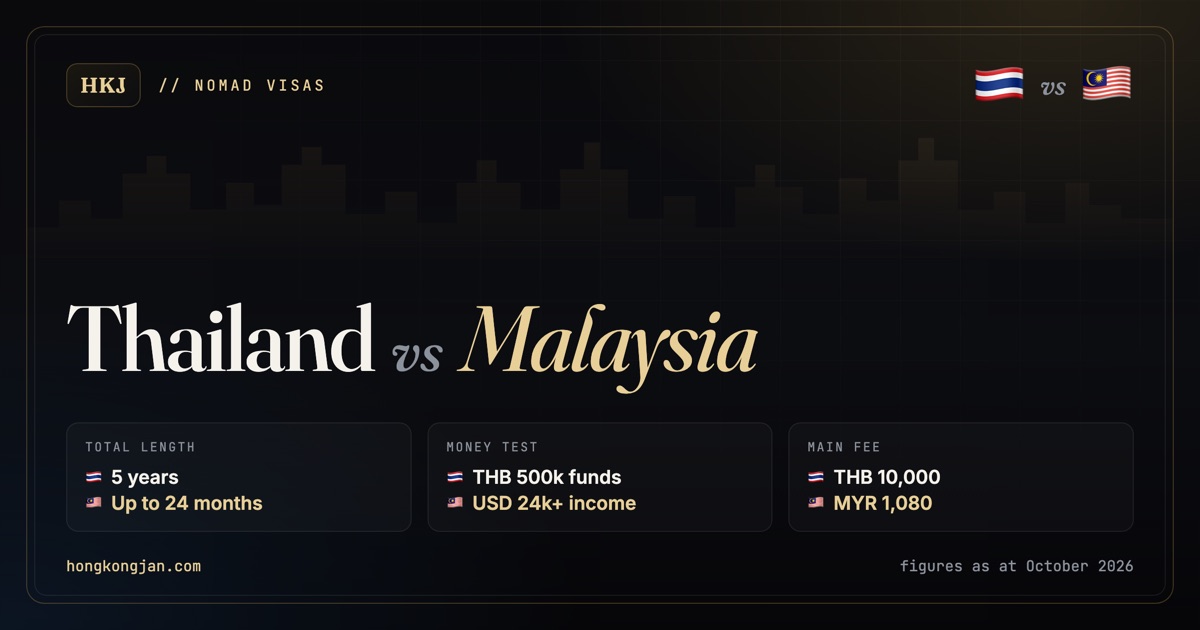
| Total length | 5 years | Up to 24 months |
| Stay per entry | 180 days, extendable once by 180 | Whole pass period |
| Financial test | THB 500,000 in funds | USD 24,000 a year (tech) or USD 60,000 (non-tech) |
| Main fee | THB 10,000 | MYR 1,080, plus MYR 360 a year pass fee |
| Dependants | Spouse and children | Spouse, children under 18, parents |
| Local clients | Not allowed | Allowed for freelancers |
| Where you apply | Thai e-Visa, from your country of nationality or permanent residence | MDEC online, from anywhere |
| Processing | Usually a few weeks, varies by embassy | 6 to 8 weeks |
Tax is where the two really differ
People choose between these two on visa terms and then get surprised by tax. Neither visa is a tax status.
Malaysia is upfront about it. MDEC's own FAQ has a tax section that says remote workers staying more than 60 days can be taxable in Malaysia. Freelancers face 10% withholding for the first 182 days and are then taxed as residents. That's why you have to register for a Malaysian tax number before the pass is endorsed.
You'll read that Malaysia exempts foreign-sourced income for resident individuals. It does, for income received from 1 January 2022 to 31 December 2036, subject to conditions. But money you earn by working while physically in Malaysia is generally treated as derived from Malaysia, so don't count on that exemption covering your day-to-day remote income.
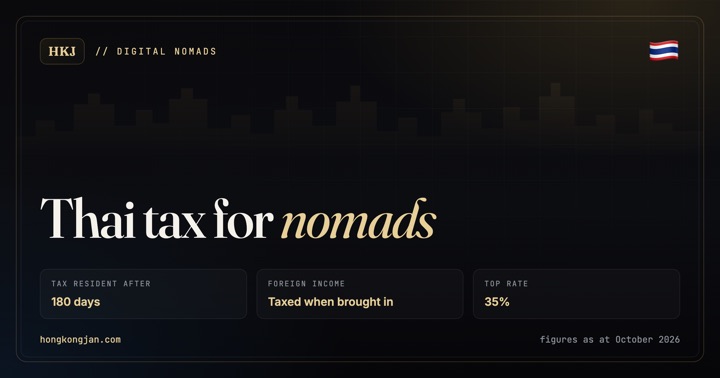
Thailand makes you tax resident once you spend 180 days or more there in a calendar year. Since 1 January 2024, residents are taxed on foreign income earned from 2024 onwards when they bring it into Thailand, whatever year it's remitted. Income from work performed in Thailand is also taxable regardless of where it's paid. A relief for income remitted in the same or following year has been proposed, but I haven't seen it become law. I've covered the detail in my guide to Thai tax for digital nomads.
Both countries also need you to think about the country you came from, which may still treat you as resident.
Living there: cost, internet and time zone
Both are among the cheaper places in the region to live well. Kuala Lumpur gives you a big-city setup for the money, with very good condo stock and English widely spoken. Thailand gives you more variety, from Bangkok to Chiang Mai to the islands, and a much bigger nomad community.
Fibre internet is fast and cheap in the main cities of both. Outside them, check before you sign a lease.
Malaysia is on UTC+8, the same as Hong Kong, Singapore and China. Thailand is on UTC+7, an hour behind. If your clients are in Greater China or you're running a Hong Kong company, Malaysia's time zone is slightly easier.
What about Indonesia
Indonesia's E33G remote worker visa has been running since April 2024. It's aimed at people employed by a company outside Indonesia, with a minimum income of USD 60,000 a year and a bank balance of at least USD 2,000. It runs for up to a year, and reports differ on how renewals work. Like the other two, it bars local employment.
It's the obvious pick if Bali is where you want to be and you clear the income bar. Recent Indonesian tax rules also treat a long-stay permit as a sign you intend to reside, so take tax advice before you go.
Which one for whom
Pick Thailand's DTV if you want flexibility over several years, you can show THB 500,000 and a settled home country to apply from, and you don't need local clients. For a freelancer on modest income, it's very good value.
Pick Malaysia's DE Rantau if you're in tech and earn over USD 24,000, if you want your family with you including parents, or if you'd like Malaysian clients too. It's also the better fit if you're thinking about a Malaysian company later.
For the visa itself, the MDEC portal is manageable on your own. A visa agent is mostly useful for getting documents right first time, especially now there's no appeal in Malaysia. For Thailand, a licensed Thai immigration lawyer is worth it if your situation is unusual, such as complex residence or income history. Be wary of anyone who guarantees approval. MDEC's own FAQ says nobody can.
Where I come in is the business side. If you're deciding whether to invoice through a Hong Kong company or set up in Malaysia, book a free fifteen-minute call and we'll work out which makes sense for you.
Common questions
Which is cheaper, the DTV or DE Rantau?
The DTV. It's THB 10,000 for five years. DE Rantau costs MYR 1,080 to apply plus a MYR 360 annual pass fee, and possibly a refundable bond.
What income do I need for DE Rantau?
USD 24,000 a year if you work in tech or digital roles, and USD 60,000 a year for non-tech roles such as founders, consultants, finance and sales.
How much money do I need for the Thai DTV?
At least THB 500,000 in funds. Some embassies ask for six months of statements, so check the one you're applying through.
Can I work for local clients on either visa?
Not on the DTV. MDEC says DE Rantau freelancers can have Malaysian clients as well as foreign ones.
Do I pay tax on either visa?
You can. Malaysia says remote workers staying over 60 days can be taxable there. Thailand taxes residents of 180 days or more on foreign income brought in. Get tax advice before you move.
Can I bring my family?
Yes, on both. The DTV covers spouses and children. DE Rantau covers spouses, children under 18 and parents, but your spouse can't work.
Can Hong Kong Jan get me the visa?
No. I don't handle visas. I can set up and run your company in Malaysia or Hong Kong, and for the visa you'd use MDEC directly, a visa agent or a licensed immigration lawyer.