Thailand is probably the most popular base in Asia for people who work from a laptop. Good food, good internet, a sensible cost of living, and since 2024 a visa that was actually designed for remote workers.
It's also a place where the online advice goes out of date fast. The visa exemption changed in September 2026. The DTV application rules changed in August 2026. The tax rules changed in 2024 and a promised fix still hasn't arrived. A lot of what you'll read in forums is simply wrong now.
So here's the setup as it stands in October 2026, in the order I'd think about it. To be upfront about my part: I set up and run Hong Kong companies, which is how a lot of remote workers in Thailand invoice their clients. I don't handle Thai visas or Thai tax returns. For those, use a licensed Thai lawyer and a Thai tax adviser, and I'll say where each one comes in.
Three ways to stay, and which one fits
Most remote workers end up choosing between three options. Here they are side by side.
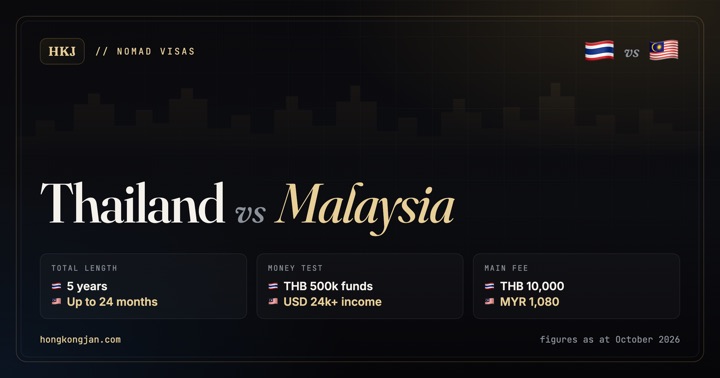
| Visa exemption | DTV | LTR (Work-from-Thailand Professional) | |
|---|---|---|---|
| Stay per entry | 30 days for most Western passports since 15 September 2026 | 180 days, extendable once by 180 days | 5 years, renewable for 5 more |
| Validity | Per entry | 5 years, multiple entry | 10 years in total |
| Main requirement | Eligible passport | THB 500,000 in funds plus proof of remote work | USD 80,000 a year income and a large foreign employer |
| Government fee | None | THB 10,000 reference, charged in local currency | THB 50,000 |
| Remote work allowed? | No, it's for tourism | Yes, for foreign employers and clients | Yes, for the foreign employer |
| Tax break | None | None | Foreign income exemption |
For most freelancers and small founders the DTV is the realistic choice. The LTR is excellent if you qualify, but the employer test rules out almost everyone who works for themselves.
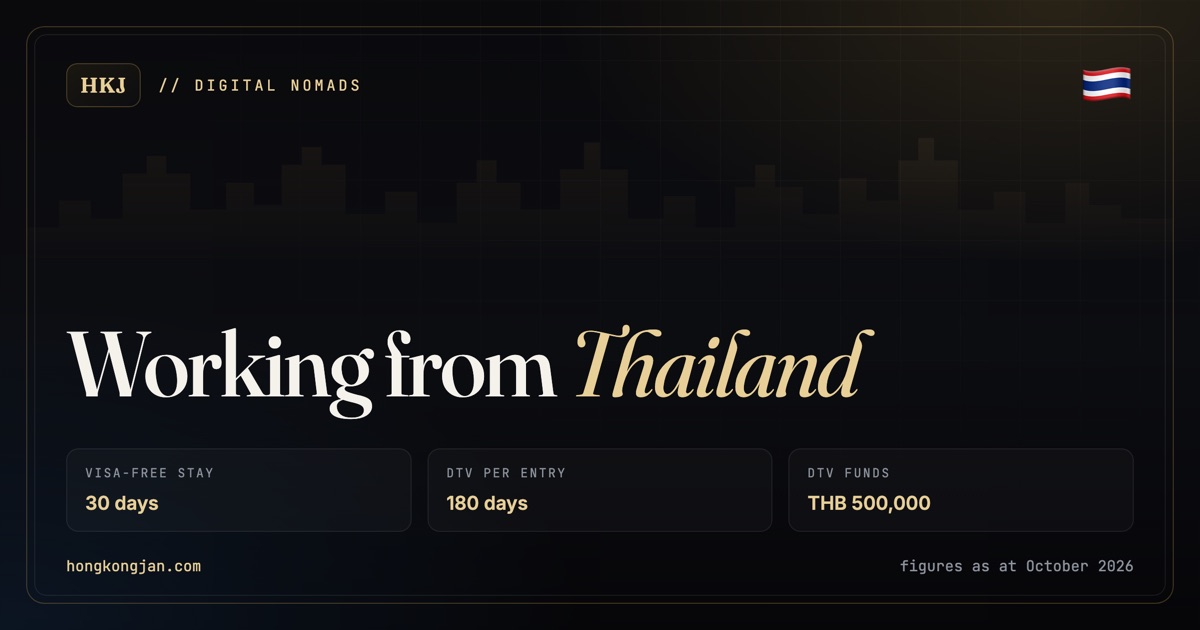
A word on the visa exemption, because it just got shorter. From July 2024 most Western passports got 60 days visa-free. That ended on 15 September 2026. The Ministry of Foreign Affairs list now gives nationals of 60 countries and territories, including the UK, the US, Canada, Australia and the EU states, 30 days. Immigration can usually extend that once by up to 30 days. Some nationalities are covered by separate bilateral agreements instead, so check your own passport.
Two things matter here. The exemption is officially for tourism, and it was never meant to cover working. And 30 days isn't long enough to settle anywhere. If you're planning to base yourself in Thailand, plan for a proper visa from the start.
The DTV in plain terms
The Destination Thailand Visa launched in July 2024. It's a five-year, multiple-entry visa. Each entry gives you 180 days, and you can extend once inside Thailand for another 180 days at an immigration office (the standard extension fee is THB 1,900). After that you leave and come back in, and the clock starts again.
The "workcation" category covers remote workers, digital nomads and freelancers. What embassies typically ask for:
- Funds of THB 500,000. Washington, for example, wants three months of statements each showing at least that balance at month end. Other missions word it differently.
- Proof of what you do. An employment contract or letter from a foreign employer, or a portfolio and client contracts if you freelance. Some embassies ask self-employed applicants for a business registration in their name.
- The fee. THB 10,000 is the reference figure, but each embassy charges its own local amount. Washington charges USD 400 and Helsinki EUR 350.
The big change this year: from 31 August 2026 you have to apply through the Thai embassy or consulate covering a country where you're a citizen or can prove legal residence. You also now need a criminal record certificate. The old trick of applying from Vientiane or Kuala Lumpur on a tourist trip doesn't work any more. You apply online through the Thai e-Visa system, from outside Thailand.
Embassy requirements vary and change without much notice, so read your own embassy's page right before you apply. A Thai immigration lawyer is worth it if your situation is unusual.
What the DTV does not let you do
This is where people get into trouble. The DTV lets you work remotely for employers and clients outside Thailand. That's it.
- No Thai employer. Working for a Thai company needs a proper non-immigrant visa and a work permit.
- No Thai clients. Selling your services to Thai businesses is working in Thailand. If you want Thai clients, you need a Thai company or a work permit route, and that's a conversation for a Thai lawyer.
- No tax holiday. The DTV says nothing about tax. If you spend 180 days or more in Thailand in a calendar year, you're a Thai tax resident like anyone else. More on that below.
The LTR, if you earn well and work for a big company
The Long-Term Resident visa is run by the Board of Investment. Its Work-from-Thailand Professional category is aimed at senior remote employees. The headline requirements from the BOI:
- Average personal income of at least USD 80,000 a year over the last two years. Between USD 40,000 and 80,000 you can still qualify with a master's degree or similar.
- An employment contract with a listed company, or a private company with at least three years of operations and USD 50 million in combined revenue over the last three years.
- Health insurance with at least USD 50,000 of cover, or one of the BOI's alternatives.
The prize is a tax exemption on foreign income you bring into Thailand. One thing I see misquoted all the time: the 17% flat tax rate belongs to the Highly-Skilled Professional category only, for Thai employment income. It doesn't apply to work-from-Thailand professionals. And this category doesn't get a Thai work permit, because your employer is abroad.
Your own small Hong Kong company won't pass the employer test. If you're a founder, the LTR is generally not your route unless you qualify under another category.
The 180-day line
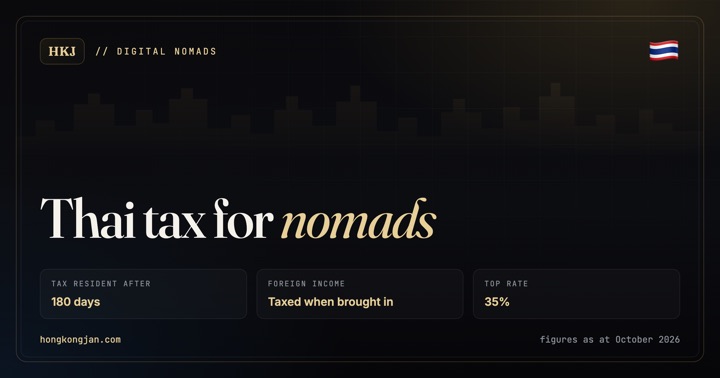
Thai tax residence has nothing to do with your visa. It's a count of days. Spend 180 days or more in Thailand in a calendar year and you're tax resident for that year.
Once you're resident, foreign income earned from 2024 onwards becomes taxable when you bring it into Thailand. Rates run from 0% up to 35%. A proposed exemption for money brought in within a year or so of earning it still isn't law. I've written the whole tax side up separately in Thailand tax for digital nomads, and it's worth reading before you move money.
A DTV holder doing the full 180 plus 180 is resident, full stop. Plan for it rather than hope it doesn't apply.
A foreign company to invoice your clients
Most serious freelancers and solo founders end up invoicing through a company rather than personally. It looks more established to clients, it keeps business money separate from yours, and it gives you a clean paper trail for your visa and your tax adviser. Many embassies are also more comfortable with a self-employed applicant who has a registered business.
A Hong Kong company is a common choice, and it's the side I handle. It suits a remote worker for a few reasons:
- No local director requirement. You can be the sole director and shareholder, living anywhere.
- Profits tax of 8.25% on the first HKD 2 million and 16.5% above, with no VAT and no tax on dividends.
- It's a respected jurisdiction for invoicing clients in Europe, the US, Australia and Asia.
The honest downsides. Every Hong Kong company needs an audit every year, with no small company exemption. A small company usually costs HKD 20,000 to 45,000 in its first year all in. And if you're doing the work from Thailand, the company's profits may not be Hong Kong sourced at all, which affects both the offshore claim in Hong Kong and whether Thailand could see the company as having a presence there. That second question is one for your Thai tax adviser, especially if you're in Thailand most of the year.
I've written more on how this works in a Hong Kong company for digital nomads.
Getting paid and moving money
Clients pay the company, into a Hong Kong account. A traditional Hong Kong bank can take months for a non-resident director, so most remote founders open a digital account with someone like Airwallex or Wise Business first, and apply to a bank alongside it. I've no commercial relationship with either. There's more detail in my guide to opening a business account as a non-resident.
Then the important habit. Only bring into Thailand what you actually need to live on, and keep a record of every transfer: date, amount, where it came from. If you're tax resident, those transfers are what the Revenue Department taxes. Keep savings from before 2024 in a separate account so you can show they're older money.
A Thai bank account is handy for daily life. Banks vary a lot on whether they'll open one for a DTV holder, so ask a couple of branches.
What not to do
- Don't set up a Thai company with Thai nominee shareholders. Using Thais to hold shares on your behalf breaks the Foreign Business Act. Penalties run to three years in prison and fines of up to THB 1 million, and the authorities have been running a large crackdown since 2024.
- Don't take Thai clients on a DTV. Even one or two local projects can count as working without a permit.
- Don't work on a visa exemption. It's for tourism.
- Don't assume the DTV is tax-free. It isn't, once you hit 180 days.
- Don't mix company and personal money. Pay yourself properly from the company, so you know exactly what you received and when.
How I'd set it up
If you're a freelancer or solo founder planning to spend most of the year in Thailand with clients elsewhere, here's the order I'd go in.
- Get the DTV from your home country or country of residence, with a Thai immigration lawyer if your paperwork is unusual.
- Set up a company outside Thailand to invoice your foreign clients. If Hong Kong fits, I can incorporate it remotely and keep it compliant.
- Before you pass 180 days in Thailand in any calendar year, sit down with a Thai tax adviser and plan how much money you'll bring in, and how.
Thailand genuinely works well for remote workers. It just doesn't work as the zero-tax, no-paperwork setup the forums describe. If you'd like to talk through the Hong Kong side for your situation, book a free call with me.
Common questions
Can I work remotely in Thailand on a visa exemption?
No. The visa exemption is for tourism, and since 15 September 2026 it's 30 days for most Western passports. If you're working, get the DTV or another suitable visa.
Can I work for Thai clients on a DTV?
No. The DTV covers remote work for employers and clients outside Thailand. Thai clients or a Thai employer need a work permit, so speak to a Thai lawyer.
How much does the DTV cost?
The reference fee is THB 10,000, charged in local currency, for example USD 400 in Washington. You also need THB 500,000 in funds, and extending inside Thailand costs THB 1,900.
Where do I apply for the DTV now?
Since 31 August 2026, at the Thai embassy or consulate covering your country of citizenship or a country where you legally reside. You also need a criminal record certificate.
Does the DTV make me exempt from Thai tax?
No. Spend 180 days or more in Thailand in a calendar year and you're tax resident, whatever your visa. Foreign income earned from 2024 is then taxable when you bring it in.
Does the LTR's 17% tax rate apply to remote workers?
No. The 17% rate is for Highly-Skilled Professionals on Thai employment income. Work-from-Thailand Professionals get an exemption on foreign income instead.
Can you set up my Thai visa or Thai company?
No. I set up and run Hong Kong companies. For Thai visas, Thai companies and Thai tax filing, use a licensed Thai lawyer and tax adviser.