For years the deal for remote workers in Thailand was simple. Earn money abroad, leave it there until the following January, then bring it in tax-free. That ended on 1 January 2024, and a lot of people living in Thailand still haven't caught up.
This is how Thai tax works for digital nomads, freelancers and remote founders as of October 2026. I'll be clear about my part: I set up and run Hong Kong companies, which is how many remote workers here invoice clients. I'm not a Thai tax adviser and this isn't tax advice. Thai rules have moved a lot since 2024, so get a Thai tax adviser to look at your own numbers.
The 180-day test decides almost everything
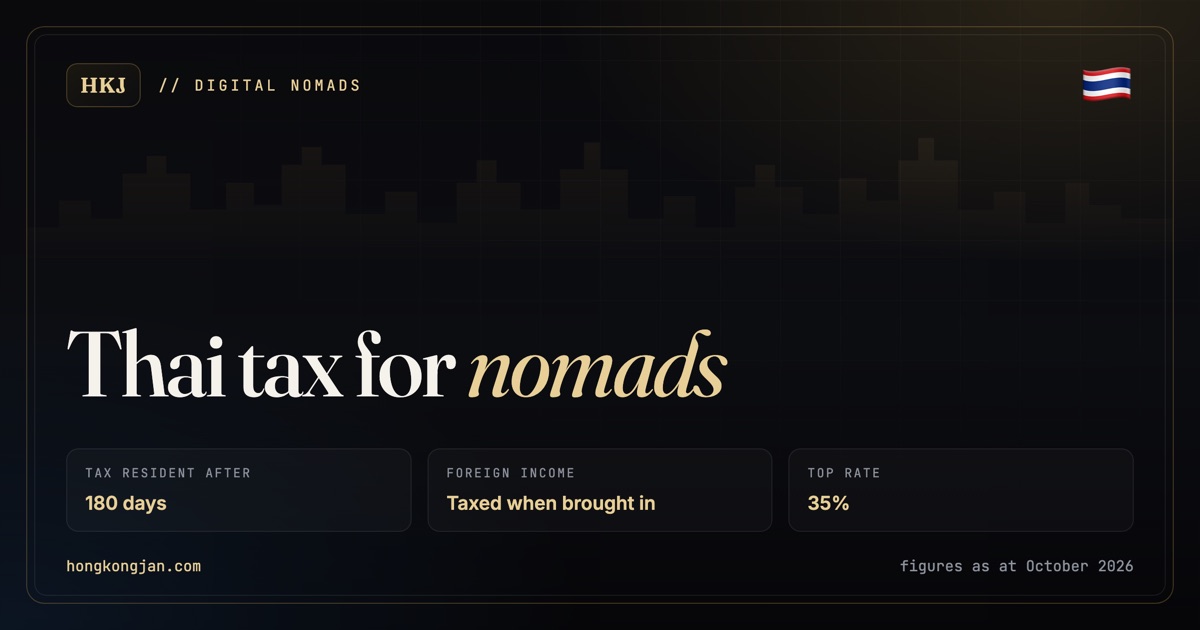
You're a Thai tax resident for a calendar year if you spend 180 days or more in Thailand in that year. The days don't need to be in one stretch. Your visa type doesn't matter, and nor does your nationality.
Under 180 days, Thailand only taxes income with a Thai source. At 180 days or more, foreign income you bring into the country comes into play as well.
Count your days properly. Your passport stamps are the evidence, and a few days either side of 180 can change your whole tax position for the year.
The 2024 remittance rule
Two Revenue Department orders changed things: Paw 161/2566 and Paw 162/2566. Since 1 January 2024, if you're tax resident, foreign income is taxable in the year you bring it into Thailand, whatever year you earned it. The old trick of waiting a year no longer works.
There's one important exception. Income earned before 1 January 2024 is grandfathered. Savings you built up before then can come in without Thai tax, as long as you can show that's what they are.
The Revenue Department's own guidance, a manual it published in November 2025, frames the test as two conditions. You're a Thai tax resident, and foreign income arising in a year you're resident is brought into Thailand. If you're moving money earned in a year you weren't resident, ask your adviser before you do it, because not everyone reads the rules the same way.
"Bringing it in" isn't only a bank transfer to a Thai account. Many advisers treat withdrawing cash from a Thai ATM with an overseas card, or spending on a foreign card while you're here, as bringing money in too. The cautious assumption is that any foreign money you end up using in Thailand counts.
The rates
Thai personal income tax is progressive. These are the bands on net income, after allowances and deductions.
| Net income (THB) | Rate |
|---|---|
| 0 to 150,000 | 0% |
| 150,001 to 300,000 | 5% |
| 300,001 to 500,000 | 10% |
| 500,001 to 750,000 | 15% |
| 750,001 to 1,000,000 | 20% |
| 1,000,001 to 2,000,000 | 25% |
| 2,000,001 to 5,000,000 | 30% |
| Over 5,000,000 | 35% |
So if you bring in modest living money, the effective rate can be fairly low. Bring in a big lump to buy a condo and you can quickly end up in the 30% and 35% bands.
The exemption everyone is waiting for is not law
In May 2025 the Revenue Department floated a fix. Foreign income brought in during the year it was earned, or the following year, would be exempt. Officials talked about a start date of 1 January 2026, and plenty of blogs reported it as done.
It isn't done. The House was dissolved, the general election took place on 8 February 2026, and the draft lost momentum. As of mid-October 2026 nothing has been published in the Royal Gazette, which is the step that turns it into law.
Plan on the rules that exist today. If the exemption does arrive, the final wording, start date and conditions may be different from what was trailed in 2025.
Work you do while sitting in Thailand
This is the point most nomad blogs skip. Thailand taxes income from employment or business carried on in Thailand, whether it's paid in Thailand or abroad, and whether or not you're resident. The remittance rule is about foreign income. Work you physically do here is arguably not foreign income at all.
In practice, the question of whether a remote worker employed by a foreign company has a "post" in Thailand has no clear official guidance. Tax treaties often protect short stays of under 183 days for employees of foreign companies with no Thai presence. Long stays get much greyer.
I'm not raising this to scare anyone. The Revenue Department's focus has been on remittances. But if you're here most of the year, earning good money, a Thai tax adviser should look at this specifically rather than you relying on the remittance rule alone.
DTV and LTR: who actually gets a tax break
DTV holders get no tax break. The Destination Thailand Visa is an immigration permission. There's nothing in the tax law that exempts DTV holders, so the 180-day test applies exactly as it does for everyone else.
Some LTR holders do. Under Royal Decree No. 743, three Long-Term Resident visa categories are exempt from tax on foreign income they bring into Thailand: Wealthy Global Citizens, Wealthy Pensioners and Work-from-Thailand Professionals. The 17% flat rate people talk about is a separate benefit for the Highly-Skilled Professional category, on Thai employment income. It doesn't apply to remote workers.
The catch is that the LTR is hard to get for a freelancer. The work-from-Thailand route needs income of around USD 80,000 a year and an employer that's listed or has substantial revenue. My Thailand digital nomad setup guide covers the visa side.
If you own a Hong Kong company: salary or dividends?
A lot of remote founders in Thailand invoice through a Hong Kong company. Here's how the money looks from the Thai side.
| Dividends | Director's fees or salary | |
|---|---|---|
| Hong Kong tax on you | None. Hong Kong has no dividend tax | Director's fees from a Hong Kong company are taxable in Hong Kong |
| Thai tax if resident | Taxable at progressive rates when brought into Thailand | Taxable when brought in, and possibly Thai-source if the work is done in Thailand |
| Foreign tax credit in Thailand | Usually nothing to credit, because no Hong Kong tax was paid by you | Hong Kong tax paid can be credited, capped at the Thai tax on that income |
Hong Kong and Thailand have had a double tax agreement since 2005. Thailand only gives a foreign tax credit where there's a treaty, and only for income tax you actually paid abroad. The company's own profits tax doesn't count as tax paid by you on a dividend, and you don't get the Thai dividend tax credit either, which is only for dividends from Thai companies.
Neither route is automatically better. Dividends are simpler and carry no Hong Kong tax, but they're fully exposed to Thai tax when they come in. Director's fees can create Hong Kong tax plus a credit. And whatever you pay yourself, the company's profits may not be Hong Kong sourced if you do all the work from Thailand. I cover that side in a Hong Kong company for digital nomads and Hong Kong salaries tax for directors.
Tax ID, filing and records
If you're Thai tax resident and bring in taxable income, you need a Thai tax identification number. Foreigners generally apply in person at the Revenue Department area office for where they live, with a passport and proof of address. Requirements vary a bit by office.
The annual return for someone with foreign or business income is the PND 90. It's due by 31 March of the following year on paper, or 8 April if you file online. The Revenue Department publishes an English version of its foreign-sourced income declaration, which goes with the return and has its own line for dividends from foreign companies.
Keep records as you go, not when a letter arrives:
- A day count for every calendar year.
- Every transfer into Thailand, with the date, amount, source account and what the money was.
- Pre-2024 savings in a separate account, so you can show the grandfathered money is old money.
- Payslips, dividend vouchers, director's fee records and any Hong Kong tax assessments.
What I'd actually do
If you're living in Thailand for most of the year and earning abroad, the practical approach is fairly simple.
- Keep your income offshore, in the company or your own foreign account, and only bring in what you need to live on.
- Plan your remittances for the year, so you know which tax band you'll land in rather than finding out in March.
- Bring in pre-2024 savings first when you need a large sum, and document it.
- See a Thai tax adviser before you pass 180 days, not after, and specifically ask about work done in Thailand.
I can't file your Thai return, and you should use a licensed Thai tax adviser for that. What I can do is set up and run the Hong Kong company so your income, director's fees and dividends are clean and documented, which makes your Thai adviser's job far easier. If that would help, book a free call with me.
Common questions
When do I become a Thai tax resident?
When you spend 180 days or more in Thailand in a calendar year. Your visa type doesn't change that.
Is money I earned before 2024 taxed when I bring it in?
No. Income earned before 1 January 2024 is grandfathered under Paw 162/2566. Keep it in a separate account so you can prove it.
Has Thailand exempted foreign income brought in within a year or two?
Not yet. The proposal from 2025 still hasn't been published in the Royal Gazette as of October 2026, so the 2024 rule still applies.
Are DTV holders exempt from Thai tax?
No. Nothing in the law exempts DTV holders. If you spend 180 days or more in Thailand, you're tax resident like anyone else.
Are dividends from my Hong Kong company taxable in Thailand?
Yes, if you're Thai tax resident and bring them in. They're taxed at progressive rates, and there's normally no Hong Kong tax to credit.
When is the Thai tax return due?
The PND 90 is due by 31 March of the following year on paper, or 8 April online.
Can you file my Thai tax return?
No. I handle the Hong Kong company side. For Thai tax registration and filing, use a licensed Thai tax adviser.