I get this question a lot from people who already live in Thailand, or are about to. They love Bangkok or Chiang Mai, they sell to clients all over the world, and they want to know whether to set up a Thai company or a Hong Kong one.
First, an honest note. I don't incorporate in Thailand and I don't have partners there. I set up and run Hong Kong companies. So for the Thai side of anything below, you need a licensed Thai lawyer and a Thai accountant. What I can do is tell you how the two compare, and where I see people get into trouble.
The 49% rule comes first
Thailand's Foreign Business Act of 1999 shapes everything else. If foreigners hold half or more of a Thai company's shares, the law treats it as a foreign company. And a foreign company can't run a restricted business without permission.
The restricted businesses sit in three lists. List 1 is closed to foreigners outright. List 2 needs approval from the Minister of Commerce and the Cabinet. List 3 needs a Foreign Business Licence from the Department of Business Development. The catch is that List 3 is wide. It covers accounting, legal and consultancy services, and it ends with a catch-all for other service businesses. In practice, almost any services company lands in it.
That's why so many Thai companies are 51% Thai owned and 49% foreign owned. It isn't a tax trick. It's the normal way to stay outside the licence requirement.
Hong Kong has nothing like this. A foreigner can own 100% of a Hong Kong company in almost any business, with no licence needed for ordinary trading or services.
Three legal ways past 49%
If you want majority foreign ownership in Thailand, there are three proper routes.
- A Foreign Business Licence. You apply to the Department of Business Development and the Foreign Business Committee reviews it. Minimum capital is THB 3 million or 25% of your estimated expenses for three years, whichever is higher, paid in before you start. Approval isn't guaranteed and it takes months.
- BOI promotion. The Board of Investment promotes specific activities Thailand wants more of, such as technology, manufacturing and regional headquarters. A promoted project can get majority or full foreign ownership plus tax incentives. It's assessed case by case, and it isn't a general pass for a small service business.
- The US Treaty of Amity. US citizens and US-owned companies can hold a majority, or all, of a Thai company in most sectors, with some areas excluded. If you aren't American, it doesn't help you.
Even when no licence is needed, a foreign-owned Thai company is expected to have at least THB 2 million of capital paid in. Thailand isn't a cheap place to own a company outright.
Why I won't recommend a Thai nominee
For years the workaround was simple. Find Thai "shareholders" to hold 51% on paper, with side agreements handing control and profit back to the foreigner. Plenty of agents still sell it.
It's illegal. Section 36 of the Foreign Business Act makes it an offence to help a foreigner get around the Act by holding shares for them, and the foreigner using the arrangement is caught too. The penalties go up to three years in prison and fines of up to THB 1 million, plus court orders to unwind the structure.
And enforcement is real now. In early 2025 the Department of Business Development said it would examine more than 26,000 companies in sectors like tourism, property, hotels and logistics for suspected nominee use. From 1 January 2026, Thai shareholders in new companies have to show three months of bank statements and proof they actually paid for their shares from their own accounts. A further order from 1 August 2026 added more paperwork for companies with foreign participation, including a formal letter explaining how the investment money moved.
My view is simple. If your Thai structure only works because someone is pretending, it doesn't work.
Tax, side by side
| Hong Kong | Thailand | |
|---|---|---|
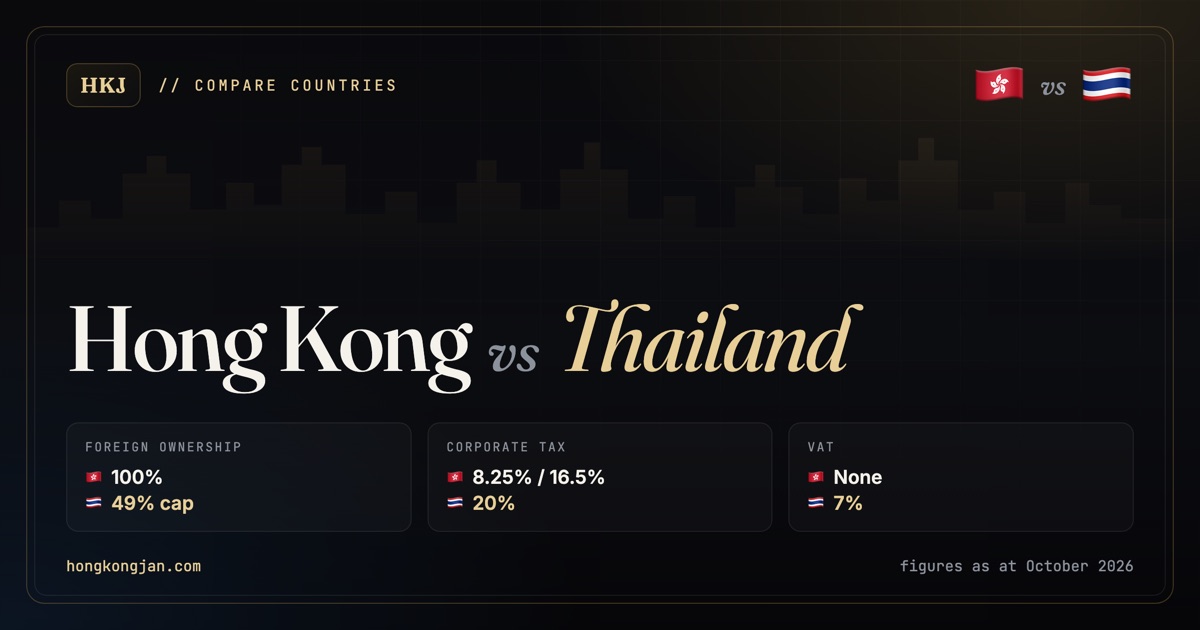
| Corporate tax | 8.25% on first HKD 2m, 16.5% above | 20% standard |
| Small company rates | The two-tier rate above applies to everyone | 0% on first THB 300,000, 15% up to THB 3m, 20% above, if paid-up capital is THB 5m or less and revenue THB 30m or less |
| VAT | None | 7%, held there until 30 September 2027. Registration once turnover passes THB 1.8m |
| Foreign ownership | 100% in almost any business | 49% cap for restricted businesses unless you have a licence, BOI promotion or the US Treaty of Amity |
| Minimum capital, foreign-owned | No minimum | THB 2m, or at least THB 3m with a Foreign Business Licence |
| Tax on dividends paid abroad | None | Withholding tax, generally 10% |
| Annual audit | Required for every company | Required for every limited company |
Thailand's small company rates are genuinely good. If your paid-up capital is THB 5 million or less and your revenue is THB 30 million or less, the first THB 300,000 of profit is tax free, profit up to THB 3 million is taxed at 15%, and the rest at 20%. For a modest consulting business that can come out close to Hong Kong. The catch is that a foreign-owned company needs THB 2 million of capital anyway, and more if you want work permits, so check you still fit under the THB 5 million line.
The bigger difference is VAT. Thailand charges it once turnover passes THB 1.8 million a year. The legal rate is 10%, but a royal decree has held it at 7% for years, and the latest extension runs to 30 September 2027. Hong Kong has no VAT at any level of revenue.
Work permits are the real cost
This is the part people underestimate. Owning a Thai company doesn't give you the right to work in it. You need the right visa and a work permit, and the company has to qualify to sponsor you.
The rule usually applied is THB 2 million of registered capital for each foreign work permit, and four Thai employees on social security for each foreigner. There are exceptions, for example for BOI-promoted companies, but for a typical small company that's the bar. So a one-person consultancy suddenly needs a payroll of four.
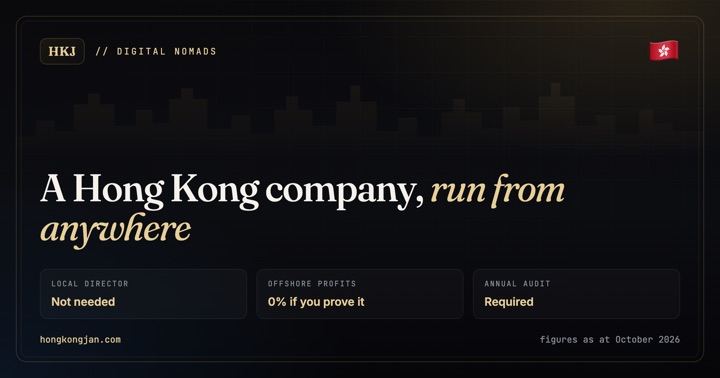
A Hong Kong company has none of this. You can be the only director and shareholder, living anywhere, and if you don't live in Hong Kong you don't need a Hong Kong visa to run it.
Living in Thailand with a Hong Kong company
This is the setup I see most. Someone lives in Thailand, their clients are in Europe, the US or Australia, and they run the business through a Hong Kong company with an international bank account. It can be a sensible structure. But it isn't a shield, and three things need thinking about.
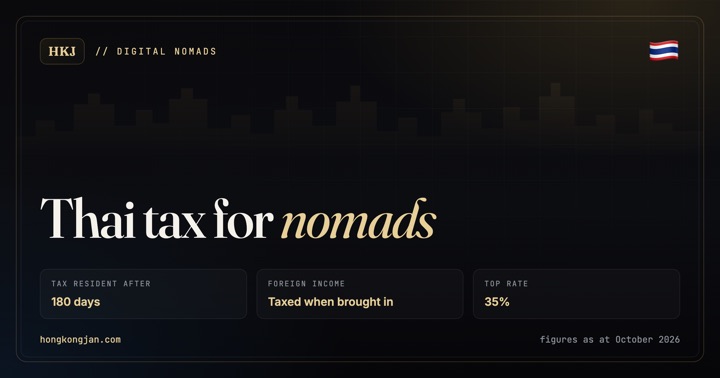
- Your personal Thai tax. Spend 180 days or more in Thailand in a calendar year and you're a Thai tax resident. Since 1 January 2024, foreign income you bring into Thailand is taxable when you remit it, whatever year it was earned. Salary or dividends from your Hong Kong company that land in a Thai account can be taxed. I go through this in my guide to Thai tax for digital nomads.
- Your company's Thai tax. Thai tax law can treat a foreign company as doing business in Thailand if someone there earns income for it. The tax treaty narrows that through its permanent establishment rules, but if you're sitting in Bangkok negotiating and closing every deal, you're handing the Thai Revenue Department an argument.
- Permission to work. If you're working in Thailand for a Thai company or Thai clients, you need a work permit. The DTV visa is aimed at remote work for employers and clients outside Thailand. It isn't a work permit.
There's a Hong Kong angle too. If none of the work happens in Hong Kong, your company may be able to make an offshore profits claim there. That can be legitimate, but it doesn't make the profit disappear. It means it's potentially taxable where the work actually happens. Here's how the offshore claim really works.
Hong Kong and Thailand have had a double tax agreement since 2005. It stops the same income being taxed twice. It doesn't decide where you owe tax in the first place, so get Thai advice on your own facts.
Audit and paperwork: a draw
Both places want audited accounts every year from every company, whatever the size. In Thailand a certified auditor signs off the statements, shareholders approve them within four months of the year end, and the corporate tax return is due within 150 days. In Hong Kong the audit is compulsory for every company too, with no small company exemption. Neither side wins this one.
Where they differ is the extras. A Thai company may also be dealing with monthly VAT returns, withholding tax filings and social security for its Thai staff. A small Hong Kong company usually has an audit, a profits tax return and an annual return, and that's about it.
So which one
If you're building a real business in Thailand, selling to Thai customers, hiring Thai staff, renting an office, you need a Thai company set up properly. That means a Foreign Business Licence, BOI promotion or the Treaty of Amity if you qualify, or a genuine Thai partner who really invests. Use a licensed Thai lawyer for it, not an agent selling nominees.
If your customers are outside Thailand and you want a company you fully own, with no VAT and no foreign ownership cap, Hong Kong is usually the better fit. Just go in with your eyes open about Thai tax residence and work permits, and get Thai advice on your personal position.
I can set up and run the Hong Kong side for you, from incorporation through to the audit. If you'd like to talk through whether it fits your situation, book a free fifteen-minute call.
Common questions
Can a foreigner own 100% of a Thai company?
Only in some cases. If the business is on the Foreign Business Act lists, which covers most services, majority foreign ownership needs a Foreign Business Licence, BOI promotion or, for Americans, the US Treaty of Amity. Otherwise the foreign stake stays at 49% or below.
Is it legal to use a Thai nominee shareholder?
No. Holding shares for a foreigner to get around the Foreign Business Act is a criminal offence for both sides, with penalties of up to three years in prison and fines of up to THB 1 million. The Department of Business Development has been actively checking Thai shareholders since 2025.
Can I live in Thailand and run a Hong Kong company?
Many people do, but it doesn't take you out of the Thai system. At 180 days you're a Thai tax resident, and income you bring into Thailand can be taxed. If you close deals from Thailand, the company itself could face Thai tax. Take advice from a Thai tax adviser on your own setup.
Is there a double tax agreement between Hong Kong and Thailand?
Yes. It was signed in 2005 and has applied in Hong Kong from the 2006/07 year of assessment. It helps stop the same income being taxed twice, but it doesn't remove tax where it's genuinely due.
What's the corporate tax rate in Thailand?
20% as standard. Small companies with paid-up capital of THB 5 million or less and revenue of THB 30 million or less pay 0% on the first THB 300,000 of profit, 15% up to THB 3 million and 20% above that.
Does a Thai company need an audit?
Yes. Every Thai limited company needs its financial statements audited by a certified auditor every year, whatever its size. Hong Kong is the same.
Can you set up my Thai company?
No. I don't incorporate in Thailand. I'd set up and run the Hong Kong side, and for the Thai company, visa and tax filings you should use a licensed Thai lawyer and accountant.