Taiwan comes up a lot in my conversations now, mostly from founders in hardware, chips and deep tech who want to be close to the supply chain. The question is usually framed as Hong Kong or Taiwan. In practice they do quite different jobs, and the setup experience is very different too.
I incorporate in both, so here's the honest comparison, including the parts of Taiwan that are genuinely better and the parts that catch foreign founders out.
Two different jobs
Hong Kong is a regional base. It's where you hold shares, sign international contracts, invoice customers across Asia, keep USD and run treasury. You can incorporate in a few days, with every director living abroad, and nobody needs to approve your investment first.
Taiwan is an operating base. You go there because the customers, engineers, fabs or component suppliers are there. A Taiwan company lets you hire locally, issue Taiwanese invoices, rent an office and sit inside one of the best technology ecosystems in the world.
If you need to be on the ground in Taiwan, a Hong Kong company won't do that job for you. If you don't, a Taiwan company is a lot of process for a business that could be run from anywhere.
Getting in: Taiwan's investment approval
This is the biggest structural difference. In Hong Kong, anyone can own 100% of a company and there's no approval step at all.
In Taiwan, a foreign investor needs prior approval before putting money in. The approval comes from the Department of Investment Review at the Ministry of Economic Affairs. You may still see it called the Investment Commission. It was renamed in a 2023 reorganisation, and it's the same body doing the same job.
Most sectors are open. A short negative list is closed or restricted, but a normal software, trading, design or consulting business is fine. Investors from Hong Kong are generally treated as foreign investors, so a Hong Kong company can be the investor.
The order goes roughly like this:
- Reserve a Chinese company name.
- Apply for foreign investment approval, with notarised and legalised documents for the investor.
- Remit the capital from overseas into a Taiwan bank account.
- Get a Taiwan CPA to verify the capital.
- Register the company, then register for business tax.
A well organised investor should allow two to three months from start to finish. Compare that with a few working days for Hong Kong.
Company types and capital
Foreign investors almost always choose between two forms.
A limited company can have a single shareholder and one to three directors, who come from the shareholders. If your Hong Kong company is the sole shareholder, it appoints a person to act as director. It's simpler to run, with no shareholder meetings, but share transfers are restricted.
A company limited by shares is the form investors and future fundraising expect. The traditional setup is a board of three directors plus a supervisor, and at least one supervisor has to live in Taiwan. A private company can now opt for just one or two directors, and a company wholly owned by a single corporate shareholder can do without a supervisor. That makes it much more workable for a Hong Kong parent.
Directors don't need to be Taiwanese or live there.
On capital, Taiwan abolished its minimum paid-in capital in 2009, so in theory there's no floor. In practice there are two. First, the capital must be verified by a Taiwan CPA before registration, and it has to cover your setup costs. Second, if you want a work permit as the company's manager, the company needs at least NTD 500,000 in capital in its first year. More on that below.
Tax, side by side
| Hong Kong | Taiwan | |
|---|---|---|
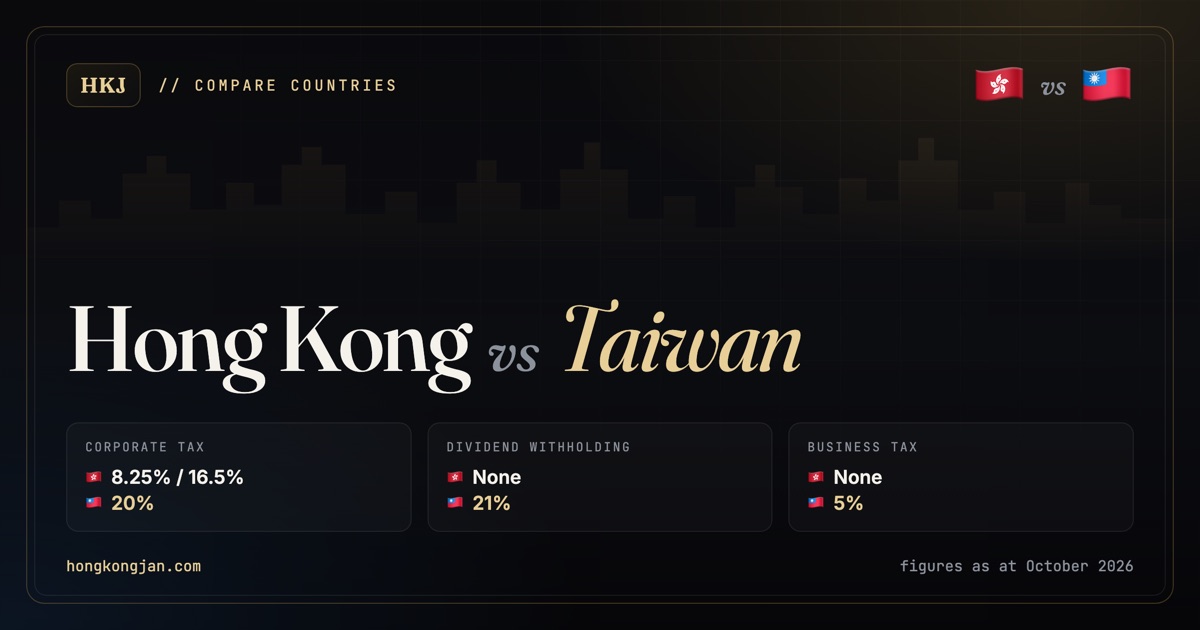
| Corporate tax | 8.25% on first HKD 2m, 16.5% above | 20%, with taxable income up to NTD 120,000 exempt |
| Tax on retained profits | None | 5% surtax on earnings not distributed by the end of the following year |
| VAT | None | 5% business tax, filed every two months |
| Dividend withholding to foreign shareholders | None | 21%, lower only under a tax treaty |
| Capital gains tax | None | Depends on the asset, usually not a simple zero |
| Tax treaty between the two | None with Taiwan | None with Hong Kong |
Taiwan's 20% is reasonable by regional standards. The real cost shows up when you take money out, which is the next section.
The 5% business tax is Taiwan's version of VAT. Every sale needs a government uniform invoice, now mostly electronic, and returns go in every two months. Hong Kong has nothing like it at any level of revenue.
Getting profits out
Hong Kong and Taiwan don't have a comprehensive double tax agreement. Taiwan isn't on Hong Kong's treaty list, and Hong Kong isn't on Taiwan's.
That matters because Taiwan withholds 21% on dividends paid to foreign shareholders. Many of Taiwan's treaty partners get that down to 10%. A Hong Kong parent can't.
So on TWD 1,000,000 of profit, the Taiwan company pays TWD 200,000 in corporate tax. Pay the remaining TWD 800,000 out as a dividend and another TWD 168,000 is withheld. That's roughly 37% all in. Leave it in the company and the 5% surtax applies instead, so there's a cost either way.
When the dividend reaches Hong Kong, it usually isn't taxed again. Hong Kong's foreign-sourced income rules can catch dividends from overseas subsidiaries, but a Hong Kong company that has held at least 5% for 12 months normally qualifies for the participation exemption, and Taiwan's 20% headline rate clears the 15% test. I cover how that works in the offshore income exemption guide.
I'll be straight about what this means. If Taiwan is your only market and you live in a country with a Taiwan tax treaty, holding the Taiwan company directly from home may cost less in withholding than holding it through Hong Kong. The case for a Hong Kong parent is structural: one common law holding company above Taiwan, the mainland and anything else you add later. It isn't a Taiwan tax saving.
Audit and running costs
Here's where Taiwan genuinely wins for a small company.
Hong Kong wants audited accounts from every company, every year, no matter how small. Taiwan doesn't. Under Taiwan's Company Act, a full CPA audit of the financial statements kicks in once paid-in capital reaches NTD 30 million, or the company gets big on revenue or headcount. Separately, once revenue gets to around NTD 100 million, the tax return itself has to be certified by a CPA. A small startup sits well below all of that.
The trade-off is more frequent filing. You've got bi-monthly business tax returns, monthly payroll withholding if you hire, and an annual income tax return in May.
| Cost | Hong Kong | Taiwan |
|---|---|---|
| Government registration fee | around HKD 1,720 | Small, from NTD 1,000 depending on capital |
| Setup, professional fees | HKD 5,000 to 12,000 | NTD 60,000 to 150,000, including investment approval and capital verification |
| Company secretary, annual | HKD 2,000 to 5,000 | Not a separate role |
| Address or office, annual | HKD 1,000 to 3,000 | NTD 24,000 to 60,000 for a business centre |
| Bookkeeping and tax filing, annual | HKD 7,000 to 20,000 | NTD 50,000 to 120,000 |
| Statutory audit | Required, HKD 5,000 to 15,000 | Not required for small companies |
Those are typical market ranges, not quotes. Taiwan's setup bill is higher mainly because of the approval stage, the notarisation and the CPA verification.
Living and working in Taiwan yourself
Owning a Taiwan company doesn't give you the right to work there. You've got two main routes.
The company sponsors you as manager. A foreign-invested company with at least NTD 500,000 in capital in its first year can apply for a work permit for a foreign manager. From then on, the company needs to show at least NTD 3 million in annual revenue to keep it. That's a real target for a new business, so plan for it.
The Employment Gold Card. This is Taiwan's combined open work permit, residence permit and visa, run by the National Development Council's Gold Card office. It's valid for one to three years and isn't tied to an employer, so you can run your own company without the company-sponsored permit. You qualify by meeting the criteria in a set field, such as digital, economy, finance or science and technology, usually through your salary history or track record. Amendments that took effect on 1 January 2026 also shortened the path to permanent residence for qualifying professionals.
If you qualify for the Gold Card, it's usually the cleaner route. Hong Kong has its own visa schemes, but for a Hong Kong company run from abroad, you don't need one at all.
If any of your investors are from the mainland
This one surprises people. Taiwan treats investment from mainland China under a separate, much stricter regime. Mainland investors can only go into industries on a short positive list, and the review is detailed.
It also reaches through holding companies. If mainland individuals or companies hold more than 30% of your Hong Kong company, directly or indirectly, or control it, Taiwan treats your Hong Kong company as a mainland investor. Since 2021 that 30% test has been applied tier by tier, so you can't dilute it by stacking companies.
If your cap table includes mainland money, tell me early. It changes what's possible in Taiwan, and it's far easier to plan around before you apply.
So which one
Choose Taiwan when you need to be there: engineers, fabs, component suppliers, Taiwanese customers, or a founder who wants to live in Taipei. The ecosystem is the reason to go, and small companies get away without a statutory audit.
Choose Hong Kong when the job is regional: holding shares, trading across Asia, invoicing international clients, or sitting above a mainland and a Taiwan subsidiary. It's faster, needs no approval, and has no VAT and no dividend withholding.
Plenty of my clients end up with both, a Hong Kong company on top and a Taiwan company doing the local work. That's the structure I describe in the Greater China holding company guide. Just go in knowing the 21% withholding doesn't go away because there's a Hong Kong company in the middle.
Because I incorporate in both places, I can set up and run the two together. If you want to talk through your own case, book a free call with me and we'll work out which order makes sense.
Common questions
Can a foreigner own 100% of a Taiwan company?
Yes, in most sectors. You need prior approval from the Department of Investment Review at the Ministry of Economic Affairs, and a small number of sectors are restricted. Mainland Chinese investors face a much tighter regime.
What's the minimum capital for a Taiwan company?
There's no statutory minimum, but a CPA has to verify the capital and it must cover your setup costs. If you want a work permit as the company's manager, plan on at least NTD 500,000.
What's the corporate tax rate in Taiwan?
20%, with taxable income up to NTD 120,000 exempt. There's also a 5% surtax on profits you don't distribute by the end of the following year.
Is there a tax treaty between Hong Kong and Taiwan?
No, there's no comprehensive double tax agreement. Dividends from a Taiwan company to a Hong Kong parent are withheld at the full 21%.
Does a Taiwan company need an audit every year?
Not if it's small. A CPA audit is required once paid-in capital reaches NTD 30 million or the company passes certain size tests. Every Hong Kong company needs an audit, whatever its size.
How long does it take to set up in Taiwan?
Allow two to three months, because of the investment approval, capital remittance and CPA verification. A Hong Kong company takes a few working days.
Can you set up both?
Yes. I incorporate in Hong Kong and Taiwan, so I can set up a Hong Kong holding company and its Taiwan subsidiary together and keep the paperwork consistent.