"Should I set up in Hong Kong or in China?" is one of the questions I hear most. It sounds like a choice between two options. Usually it isn't.
A Hong Kong company and a mainland company do different things, and a lot of businesses selling into China end up with both. I incorporate in Hong Kong and on the mainland, so here's how I explain the difference to clients, with the current rules and numbers.
What each one can actually do
A Hong Kong company can sell to mainland customers from outside. It can invoice them in USD or HKD, source from mainland factories, hold IP and sign international contracts. You can set it up in a few working days, run it from anywhere, and move money in and out freely.
What it can't do is operate inside the mainland. It can't employ staff there on local contracts, rent an office in its own name, collect RMB from local customers with an official fapiao, or hold the licences many sectors need.
A mainland company does all of that. For a foreign owner, the usual vehicle is a wholly foreign-owned enterprise, or WFOE. It's a full Chinese limited liability company, owned 100% from outside.
So the real question is whether you need to be inside the mainland market. If you do, you need a mainland entity. If you don't, a Hong Kong company is simpler, cheaper and much more flexible.
The rules for foreign-owned companies now
The Foreign Investment Law took effect on 1 January 2020. It replaced the old separate laws for joint ventures and WFOEs. Foreign-invested enterprises now follow the same Company Law as domestic companies. People still say "WFOE" and so do I, but legally it's simply a foreign-invested enterprise.
A Hong Kong company or a Hong Kong resident investing on the mainland is treated as a foreign investor under these rules.
What you can invest in is set by the national negative list. Anything not on it is open to foreign investors on the same terms as local ones. The 2024 edition, in force from 1 November 2024, cut the list to 29 items and removed every remaining restriction on manufacturing. Most of what's left is in areas like telecoms, media, publishing, education and some financial and internet services. A trading, consulting, software or manufacturing business is normally fine.
Once you're set up, each foreign-invested enterprise also files an annual foreign investment information report between 1 January and 30 June.
Registered capital and the five-year rule
There's no fixed minimum registered capital for most WFOEs. But the rule on paying it in changed in a big way.
Under the revised Company Law, in force since 1 July 2024, shareholders of a limited liability company must pay in their full subscribed capital within five years of the company being set up. Companies formed before then have until 30 June 2027 to bring their payment schedule in line, with everything paid by 30 June 2032 at the latest.
The old habit of declaring a big registered capital to look impressive and never paying it is over. Shareholders are liable for what they've subscribed. My advice is to set capital at a realistic amount, enough to fund the company until it covers its own costs, and plan the cash injections. Increasing capital later is a routine filing. Reducing it is a much harder process.
Tax, side by side
| Hong Kong | Mainland China | |
|---|---|---|
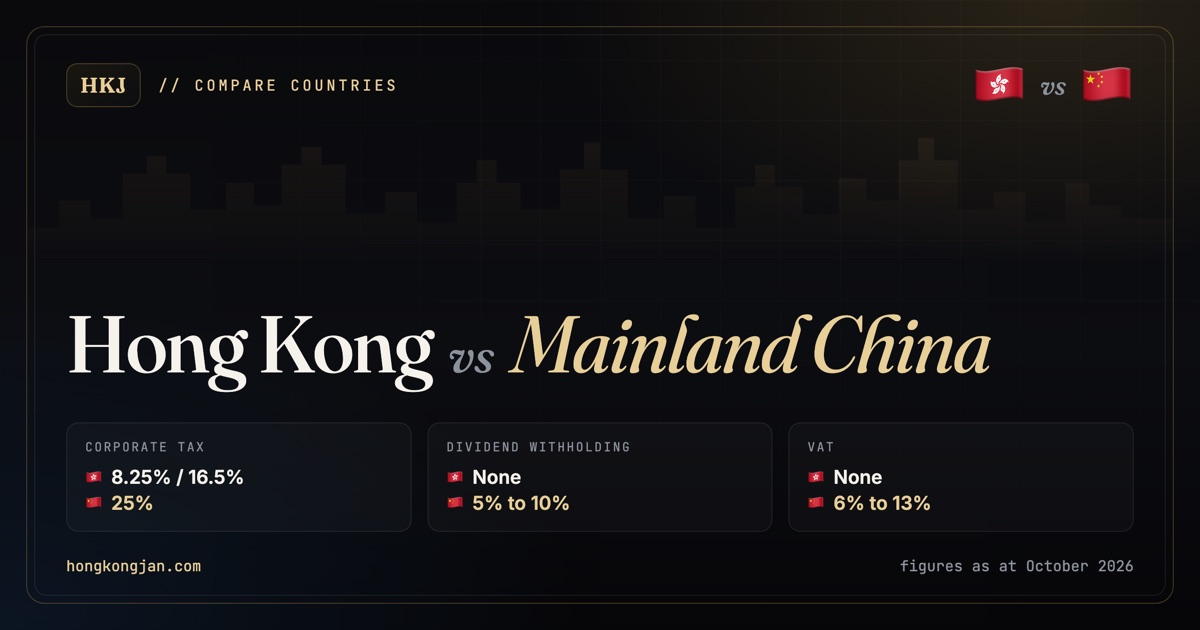
| Corporate tax | 8.25% on first HKD 2m, 16.5% above | 25% standard, 15% for qualifying high-tech companies |
| Small company relief | The two-tier rate | Effective 5% on taxable income up to CNY 3m for small low-profit enterprises, to end of 2027 |
| VAT | None | 13% goods, 9% transport and property, 6% most services |
| Dividend withholding | None | 10%, or 5% to a qualifying Hong Kong parent |
| Tax on dividends received | Usually exempt | Not applicable |
The small low-profit enterprise relief is genuinely useful for a new WFOE. To qualify, the company needs annual taxable income of no more than CNY 3 million, no more than 300 employees and total assets of no more than CNY 50 million. Meet all three and only 25% of taxable income is taxed, at 20%, which works out at 5%. That beats Hong Kong's 8.25% on the same slice of profit, and it runs to 31 December 2027.
VAT is the bigger day-to-day difference. The new VAT Law took effect on 1 January 2026 and kept the 13%, 9% and 6% rates. A small WFOE with sales under CNY 5 million a year can register as a small-scale taxpayer, which currently pays a reduced 1% rate under a concession to the end of 2027, but can't reclaim input VAT. Either way, every sale runs through the official fapiao system. Hong Kong has no VAT at all.
Getting profits out of the mainland
Money goes into China easily. Getting it out takes steps, and this is where planning pays off.
Before a WFOE can pay a dividend, it normally needs to:
- Finish its annual audit and corporate tax reconciliation for the year.
- Make up any losses from earlier years.
- Put 10% of after-tax profit into a statutory reserve, until the reserve reaches 50% of registered capital.
- Pass a shareholder decision to distribute.
- Complete a tax filing for the outbound payment, needed for single payments over USD 50,000, and pay the withholding tax.
The bank then remits the money. It's routine once you've done it once, but it's annual, so most WFOEs pay dividends once a year.
The standard withholding rate on dividends to a foreign shareholder is 10%. Under the arrangement between the mainland and Hong Kong, it drops to 5% if the Hong Kong company directly owns at least 25% of the WFOE and is the beneficial owner of the dividend. There's also a principal purpose test, added in 2019, so a structure set up mainly to get the lower rate can be denied it.
The tax bureau does check. Benefits are self-assessed and reviewed later, and in 2025 one listed group disclosed that its mainland subsidiary was told to withhold at 10% instead of 5%. A Hong Kong holding company with real decision-making, its own bank account and some genuine activity is in a much stronger position than a shell at a virtual address.
Once the dividend reaches Hong Kong, it's normally exempt. A Hong Kong company holding at least 5% for 12 months usually meets the participation exemption under Hong Kong's foreign-sourced income rules, since the mainland's 25% headline rate clears the 15% test.
And if you'd rather keep the money in China, foreign investors who reinvest mainland dividends into qualifying new investment can claim a 10% tax credit from 2025 to 2028.
Audit, compliance and running costs
Both places expect an annual audit. Every Hong Kong company needs one. On the mainland, an annual audit by a Chinese CPA firm is standard practice for WFOEs, and you can't pay dividends without it.
The mainland calendar is busier, though. VAT and payroll filings are monthly or quarterly, corporate tax is prepaid quarterly, the annual tax reconciliation is due by 31 May, and the foreign investment report by 30 June.
| Cost | Hong Kong | Mainland WFOE |
|---|---|---|
| Government registration fee | around HKD 1,720 | Little or none |
| Setup, professional fees | HKD 5,000 to 12,000 | CNY 15,000 to 40,000 |
| Registered address | HKD 1,000 to 3,000 a year | A real lease, from a few thousand CNY a month |
| Bookkeeping and tax filing, annual | HKD 7,000 to 20,000 | CNY 18,000 to 48,000 |
| Annual audit | HKD 5,000 to 15,000 | CNY 8,000 to 20,000 |
Those are typical market ranges, not quotes. The biggest mainland cost is often the one people forget, a proper office lease, because most cities won't accept a virtual address.
Timelines and the people you need
A Hong Kong company takes a few working days. A WFOE realistically takes one to three months from documents to a working company, with a business licence, bank accounts, tax registration and foreign exchange registration all in place.
Your foreign documents need to be authenticated before the mainland will accept them. For a Hong Kong parent company, that's done by a China-Appointed Attesting Officer. Most other countries now use an apostille, since China joined the Apostille Convention in November 2023.
Every WFOE needs a legal representative. Since the 2024 Company Law, that must be a director or manager who actually runs the company's affairs. It can be a foreigner, but it's a role with real personal liability, and banks and tax bureaus increasingly want that person verified in person. Small companies can now drop the supervisor if all shareholders agree.
Why most people end up with both
The standard structure is a Hong Kong company owning the WFOE. The Hong Kong company holds the shares, the IP and the international contracts, and takes the dividends at 5% rather than 10%. The WFOE does the local work in RMB.
Hong Kong also gets you CEPA, the trade arrangement in force since 2004 that gives Hong Kong goods and service providers preferential access to the mainland. And it keeps your group's money outside the mainland's capital controls.
The order matters. Set up the Hong Kong company first, then use it to invest in the WFOE. Doing it the other way round means restructuring later, which is slow and expensive on the mainland. I go through the full setup in the Greater China holding company guide.
So which one
If you're selling into China, sourcing from it or testing the market, start with Hong Kong. It's fast, cheap to run, has no VAT and no capital controls, and many businesses never need more.
When you need staff, an office, RMB revenue or a licence on the mainland, add a WFOE underneath it. With the small low-profit relief, a modest WFOE can be surprisingly tax-efficient.
What I'd avoid is setting up a WFOE straight from home with no Hong Kong layer, or a Hong Kong company with no substance that won't hold up when the tax bureau checks. Because I do both sides, I can set up and run the two together. Book a free call with me and we'll work out what you need now and what can wait.
Common questions
Can a foreigner own 100% of a company in China?
Yes, in any sector not restricted by the national negative list. The 2024 edition has 29 items and no restrictions left on manufacturing. The usual vehicle is a wholly foreign-owned enterprise, or WFOE.
Is there a minimum registered capital for a WFOE?
Not for most businesses. But under the 2024 Company Law, whatever capital you subscribe has to be paid in within five years, so set a realistic figure.
What's the corporate tax rate in China?
25% as standard, 15% for qualifying high-tech companies. Small low-profit enterprises pay an effective 5% on taxable income up to CNY 3 million until the end of 2027.
What's the withholding tax on dividends from China to Hong Kong?
10% as standard, reduced to 5% if the Hong Kong company directly owns at least 25% and is the beneficial owner. The tax bureau can deny the lower rate to shell companies.
Does a WFOE need an audit?
In practice, yes. An annual audit by a Chinese CPA firm is standard, and you need it before you can pay dividends. Every Hong Kong company needs an audit too.
How long does it take to set up a WFOE?
Usually one to three months to be fully operational, including bank and tax registration. A Hong Kong company takes a few working days.
Can you set up both the Hong Kong company and the WFOE?
Yes. I incorporate in Hong Kong and mainland China, so I can set up the holding company and the WFOE together and run the compliance on both.