Indonesia is one of the biggest markets in Asia, with more than 270 million people, and a lot of founders want in. The question I get most is whether to set up a PT PMA straight away, or start in Hong Kong and go in later.
The honest answer is that they aren't really alternatives. A PT PMA is how a foreigner operates inside Indonesia. A Hong Kong company is a base for doing business anywhere, Indonesia included. Here's how they compare, including the 2025 and 2026 rule changes that a lot of older guides still miss. I set up companies in both, so this is the view from doing the work, not from a brochure.
Indonesia is a market, Hong Kong is a base
If your customers are in Indonesia, you'll probably need an Indonesian company sooner or later. Without one you can't properly hire local staff, hold most business licences, import in your own name or invoice like a local supplier. For a foreign owner, that company is a PT PMA, a limited liability company with foreign investment.
If you sell into Indonesia from outside, or you're still testing the market, a Hong Kong company can invoice Indonesian clients from day one with none of that setup. Just watch the point where you start having people or a fixed place of business in Indonesia, because that can create a taxable presence there.
So the first question is simple. Do you need to be on the ground in Indonesia, or just selling to it?
The capital rule changed in late 2025
For years the headline number put most small founders off. A PT PMA needed IDR 10 billion of issued and paid-up capital, roughly USD 600,000.
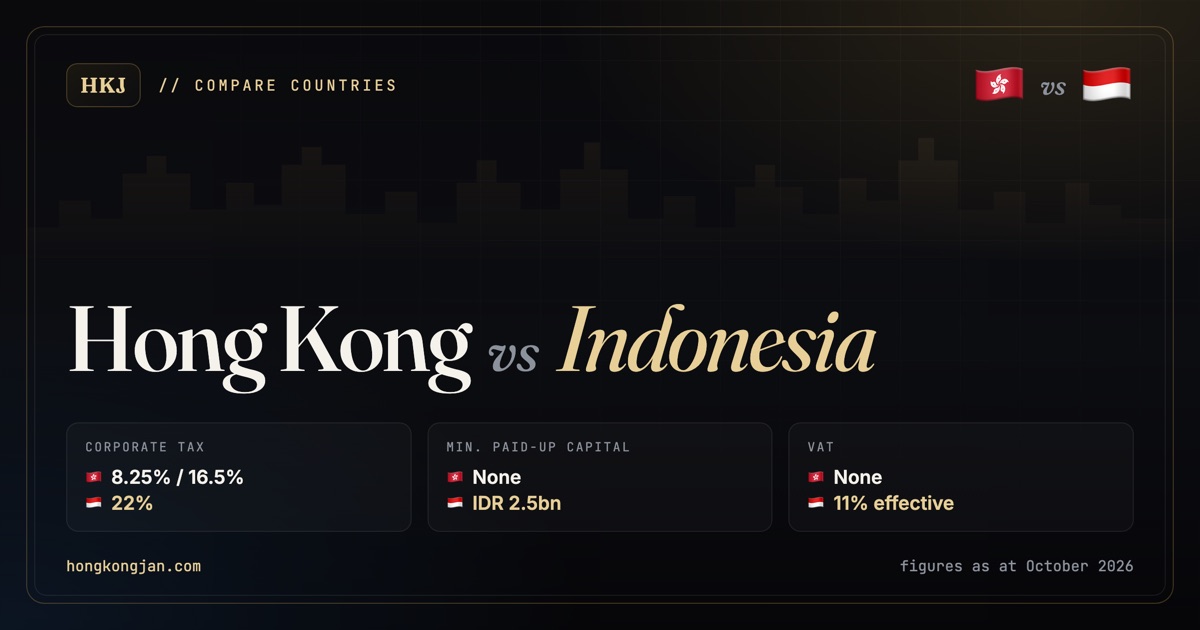
BKPM Regulation 5 of 2025, issued in October 2025, cut the minimum paid-up capital to IDR 2.5 billion, roughly USD 150,000. That's a big change. But two things didn't move as much as people think:
- The investment plan is still IDR 10 billion. Your total planned investment must still be more than IDR 10 billion per five-digit KBLI business code, per location, normally excluding land and buildings. The part above your paid-up capital can be made up of equipment, fit-out, permits and operating spend. Related KBLI codes can now be grouped under one investment value, so you don't need a separate IDR 10 billion for each.
- The cash has to stay put. The paid-up capital is expected to sit in the company's Indonesian bank account for 12 months, unless it's spent on the business itself.
Compare Hong Kong, where there's no minimum capital at all. You can incorporate with a single share. For a founder testing a market, that alone often decides it.
What you can own, and the OSS licence
Most sectors are open to 100% foreign ownership under Indonesia's Positive Investment List, which is Presidential Regulation 10 of 2021 as amended by Regulation 49 of 2021. Some activities are reserved for small local businesses or cooperatives, some are capped, and some need extra sector licences. Your KBLI code decides which bucket you're in, so pick it carefully. Changing it later is a hassle.
Licensing runs through OSS-RBA, Indonesia's online single submission system. Government Regulation 28 of 2025 replaced the 2021 licensing rules, and each business activity is still graded by risk. Low-risk activities need only a business identification number, the NIB. Higher-risk ones need standard certificates or a full licence, and often a real office rather than a virtual one.
A PT PMA also needs at least two shareholders, at least one director and at least one commissioner, and it files regular investment activity reports (LKPM) with the investment ministry. A Hong Kong company needs one shareholder and one director, and has nothing like LKPM.
Tax, side by side
| Hong Kong | Indonesia | |
|---|---|---|
| Corporate tax | 8.25% on first HKD 2m, 16.5% above | 22% |
| Small company relief | Two-tier rate, whoever owns the company | Rate halved on profit linked to the first IDR 4.8bn of turnover, if turnover is IDR 50bn or less |
| VAT | None | 12% headline, effectively 11% on most goods and services |
| Withholding tax on dividends paid abroad | None | 20%, reduced to 5% or 10% for Hong Kong shareholders under the treaty |
| Capital gains | None | Taxed as ordinary company income |
| Tax treaty between them | Yes, in force since 2012 | Yes, same treaty |
The VAT story confused everyone in early 2025. The law moved the rate to 12% from 1 January 2025. But under Finance Ministry Regulation 131 of 2024, most goods and services are taxed on a base of 11/12 of the price, so the effective rate stays at 11%. The full 12% only bites on luxury goods. Businesses have to register for VAT once turnover passes IDR 4.8 billion a year. Hong Kong has no VAT at any level.
The small business tax breaks, and which one you'll actually get
Two Indonesian reliefs get quoted a lot, and foreign founders often get pointed at the wrong one.
The 0.5% final tax. Indonesia has a final tax of 0.5% of gross turnover for small businesses with turnover up to IDR 4.8 billion. Government Regulation 20 of 2026, in force since April 2026, narrowed it to individuals, single-owner PT Perorangan companies and cooperatives. Ordinary companies with two or more shareholders, PT PMAs included, are out, apart from some that were already using it under the old time limits. A PT Perorangan is only for Indonesian citizens. So if you're setting up a PT PMA now, plan on not having the 0.5% rate.
The Article 31E rate cut. This is the one a PT PMA can use. If gross turnover is IDR 50 billion or less, the 22% rate is halved to 11% on the share of taxable profit that relates to the first IDR 4.8 billion of turnover. If your turnover is under IDR 4.8 billion, all your profit gets the 11% rate.
So a small PT PMA pays roughly 11% on profit, which isn't far from Hong Kong's 8.25%. The bigger gaps are VAT, the 20% withholding on dividends going abroad, and the cost of monthly compliance.
Directors, visas and people on the ground
Indonesian company law doesn't require a director to be Indonesian or to live in Indonesia. Foreigners can be directors and commissioners.
The catch is the work side. A foreigner who actually works in Indonesia, including as a director, needs an approved foreign worker plan (RPTKA), a work visa and a KITAS stay permit. In most cases the employer also pays a foreign worker levy of USD 100 a month per foreign worker. Some roles, including HR director, are closed to foreigners. There is an investor KITAS route, but it's aimed at shareholders with a large personal stake, so most small founders end up on the working route.
In practice someone also has to be reachable in Indonesia for the bank, the tax office and OSS. That's usually a local manager or a trusted local director.
Hong Kong has none of this. Directors can live anywhere, and you only need a visa if you move to Hong Kong to work. If you want the Hong Kong side done without flying in, here's how remote incorporation works.
Costs and timeline
| Item | Hong Kong | Indonesia (PT PMA) |
|---|---|---|
| Minimum paid-up capital | None | IDR 2.5bn, about USD 150,000 |
| Government and notary fees | around HKD 1,720 | IDR 10 million to 20 million |
| Registered or virtual office, annual | HKD 1,000 to 3,000 | USD 500 to 1,500, and some areas need a physical office |
| Accounting and tax filings, annual | HKD 7,000 to 20,000 | USD 2,000 to 6,000, with monthly tax returns |
| Statutory audit | Required every year, HKD 5,000 to 15,000 | Required above size thresholds or when a bank or licence asks |
| Foreign director work permit and KITAS | Not required | USD 1,500 to 3,000 per person a year, plus the levy |
| Time to incorporate | 1 to 3 working days | Usually 4 to 8 weeks for deed, approval, NIB and tax ID |
Then add banking in both places, and the KITAS process in Indonesia if you're moving there. Realistically, a PT PMA takes two to four months before it's fully trading with a foreign director in place. A Hong Kong company can be invoicing within a week or two if you use a digital banking platform while the traditional bank account is processed.
A Hong Kong company on top of a PT PMA
This is the structure I set up most often for Indonesia. The Hong Kong company owns most of the PT PMA, and the founder or a second company holds the rest, because a PT PMA needs two shareholders.
Why bother?
- Lower withholding on dividends. Indonesia normally withholds 20% on dividends paid abroad. Under the Hong Kong and Indonesia double tax agreement it drops to 5% if the Hong Kong company owns at least 25% of the PT PMA, and 10% otherwise. Interest drops to 10% and royalties to 5%. To claim it, the Hong Kong company needs real substance and the treaty paperwork Indonesia's tax office asks for.
- A clean place to hold the investment. Co-investors, partners and lenders are often more comfortable with a Hong Kong parent. A future sale still needs planning, because Indonesia has anti-avoidance rules aimed at offshore share sales.
- A regional hub. If you also sell into China, Taiwan or the rest of Asia, the Hong Kong company does that work while the PT PMA handles Indonesia.
On the Hong Kong side, dividends from the PT PMA fall under Hong Kong's foreign-sourced income exemption rules. Because Indonesia taxes company profits well above 15%, they usually fit the participation exemption, but check your facts. My guide to Hong Kong's offshore income rules covers the basics.
So which one
Pick Indonesia, meaning a PT PMA, if Indonesia is your market and you need to hire, hold licences, import or invoice locally. The 2025 capital cut made it far more reachable for smaller foreign businesses, and the 11% effective rate for small companies is fair.
Pick Hong Kong if you're still testing Indonesia, selling into it from outside, or running a regional business where Indonesia is one market of several. No capital requirement, no VAT, no dividend withholding, and you can be trading within days.
If Indonesia is serious, the answer is often both, in that order. Hong Kong first as the holding and regional company, then a PT PMA underneath when the Indonesian business is real. I do both sides, so book a free fifteen-minute call and we'll work out the right order for you.
Common questions
How much capital does a PT PMA need in 2026?
Minimum paid-up capital is IDR 2.5 billion since BKPM Regulation 5 of 2025, down from IDR 10 billion. The total investment plan must still be more than IDR 10 billion per KBLI business code per location.
Can a foreigner own 100% of an Indonesian company?
In most sectors, yes, through a PT PMA. Check your KBLI code against the Positive Investment List first, and remember a PT PMA needs at least two shareholders.
Is Indonesia's VAT 11% or 12%?
Both, in a way. The rate is 12%, but for most goods and services it's charged on 11/12 of the price, so the effective rate is 11%. The full 12% applies to luxury goods.
Can a PT PMA use the 0.5% small business tax?
Not if you're setting one up now. Since April 2026 it's limited to individuals, single-owner PT Perorangan companies and cooperatives. A small PT PMA can use the Article 31E rate cut instead, which brings its rate down to about 11%.
Does a PT PMA need an Indonesian director?
Not legally. Foreigners can be directors, but a foreigner working in Indonesia needs an approved RPTKA, a work visa and a KITAS. Hong Kong has no director residence rules at all.
Is there a tax treaty between Hong Kong and Indonesia?
Yes. It was signed in 2010 and has been in force since 2012. Indonesian withholding on dividends to a Hong Kong company drops from 20% to 5% or 10%.
How long does it take to set up a PT PMA?
Usually four to eight weeks for the company itself, then longer for banking and any work permits. A Hong Kong company takes one to three working days.