I get asked about Malaysia more than you'd think. Usually it's someone who has priced up a Hong Kong company, then seen what an office and a team cost in Kuala Lumpur, and wondered if they're missing a trick.
Sometimes they are. Malaysia is genuinely cheaper to run real operations in. But for a foreign founder who isn't moving there, the tax maths and the paperwork look quite different from the brochure. I set up companies in both, so I've no reason to push you either way. Here's the honest comparison.
Decide what the company is actually for
A Hong Kong company and a Malaysian Sdn Bhd are good at different jobs.
Hong Kong is a base. It suits holding companies, trading companies, consultancies selling across Asia, and founders who want to run everything remotely. Simple tax, no local director rule, no minimum capital to speak of.
Malaysia is a place to operate. Office rent, salaries and everyday costs are well below Hong Kong. If you need a real team, a warehouse or a service centre for ASEAN customers, that saving can matter far more than a few points of tax.
So start with one question. Will people actually work for this company in Malaysia? If yes, keep an open mind. If no, Hong Kong will almost always be simpler and cheaper.
Tax, side by side
| Hong Kong | Malaysia | |
|---|---|---|
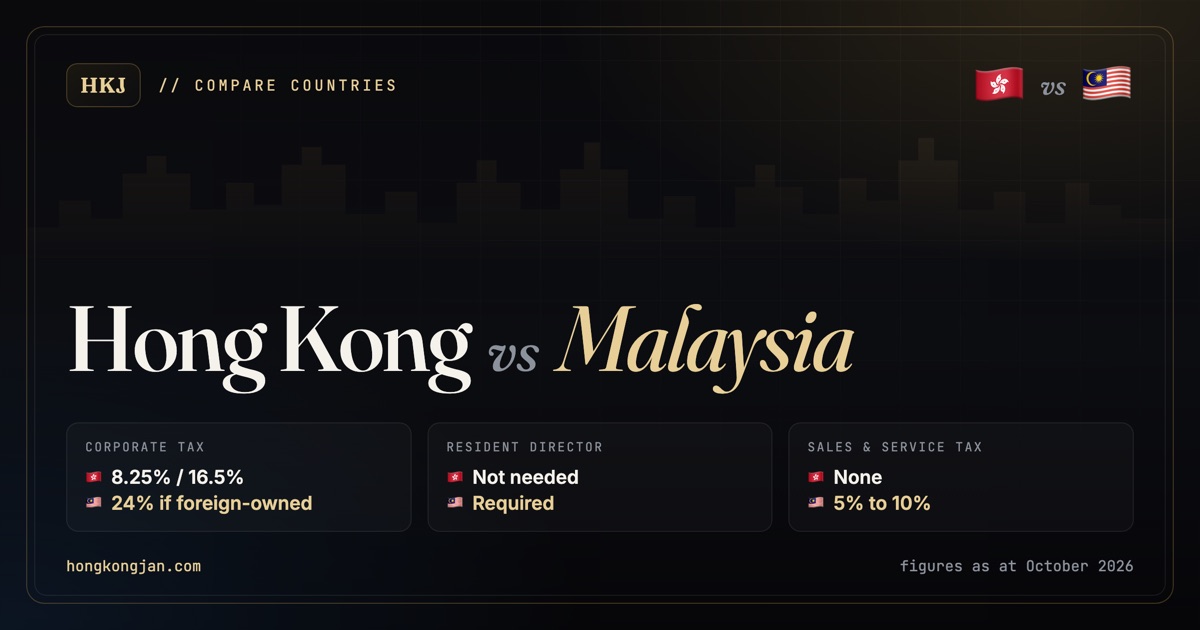
| Corporate tax | 8.25% on first HKD 2m, 16.5% above | 24% standard. 15% and 17% on the first MYR 600,000 for qualifying SMEs only |
| Sales tax or VAT | None | Sales tax 5% or 10%, service tax 6% or 8% |
| Capital gains tax | None | Companies pay tax on gains from unlisted Malaysian shares since 1 March 2024 |
| Tax on dividends | None | No withholding. 2% for individuals on dividends above MYR 100,000 a year, from 2025 |
| Tax treaty between them | Yes, in force since 2012 | Yes, same treaty |
On paper the gap looks small, because people quote Malaysia's 15% SME rate. For most of my clients, that rate isn't on the table. Here's why.
Why Malaysia's SME rate probably won't apply to you
Malaysia taxes qualifying SMEs at 15% on the first MYR 150,000 of chargeable income and 17% on the next MYR 450,000. Everything above MYR 600,000 is at 24%.
To qualify, the company has to be Malaysian resident, with paid-up capital of MYR 2.5 million or less and gross business income of MYR 50 million or less, and it can't control or be controlled by a company with more than MYR 2.5 million of paid-up capital.
Then comes the one that catches foreign founders. No more than 20% of the paid-up capital can be owned, directly or indirectly, by foreign companies or non-Malaysian citizens. If you own your Sdn Bhd yourself, or through a Hong Kong company, you're over that line. Your company pays 24% from the first ringgit.
Hong Kong's 8.25% band doesn't care who owns the company. The only catch is that within a group of connected companies, just one can claim it. On profit of around USD 100,000, a foreign-owned Sdn Bhd pays roughly three times what a Hong Kong company would. There's more on the Hong Kong side in my guide to the Hong Kong corporate tax rate.
The taxes Hong Kong doesn't have
Sales and service tax. Malaysia runs SST rather than a GST, and the scope widened a lot on 1 July 2025. Sales tax on non-essential goods is now 5% or 10%. Service tax is 6% or 8% depending on the service, and it now reaches rental and leasing, construction, fee-based financial services, private healthcare and education. Most service businesses register once taxable services pass MYR 500,000 over 12 months, though thresholds vary by category. It's another return and another thing to price in.
Capital gains tax. Since 1 March 2024, a company that sells shares in an unlisted Malaysian company pays tax on the gain, normally 10% of the net gain. For shares bought before 2024 there's an option to pay 2% of the gross sale price instead. If your plan is to build something and sell it, factor this in. Hong Kong has no capital gains tax.
Dividend tax. Malaysia still doesn't withhold tax on dividends paid out. But from the 2025 year of assessment, individual shareholders pay 2% on Malaysian dividends above MYR 100,000 a year, and that includes non-resident individuals. It's small, but it's new.
E-invoicing. Malaysia has been phasing in mandatory e-invoices through the tax office's MyInvois system. Smaller businesses are exempt below a turnover threshold that's been raised more than once, so check where you sit before you pick accounting software.
The resident director rule, and the capital you might need
Hong Kong has no local director requirement. Every director can be a foreign national living anywhere.
Malaysia does have one. Section 196 of the Companies Act 2016 says a private company needs at least one director whose principal place of residence is in Malaysia. In practice that's a Malaysian citizen, a permanent resident, or a foreigner who genuinely lives there on a proper pass. If you're not moving, you'll pay for a nominee resident director, usually MYR 3,000 to 8,000 a year. As with any nominee, the fee is the smaller issue. You're putting someone you may never meet into a role with real legal responsibility.
If you are moving to run the company yourself, look at the capital rules before you commit:
- A 100% foreign-owned company sponsoring Employment Passes is generally expected to have paid-up capital of around MYR 500,000.
- Majority foreign-owned businesses in wholesale, retail or trade usually need a WRT licence, which comes with a MYR 1 million paid-up capital expectation.
- Employment Pass salary floors went up sharply for applications from 1 June 2026. Category I now starts at MYR 20,000 a month, and the lowest category at MYR 5,000.
None of that applies to a Hong Kong company. You can incorporate with a single share and appoint yourself as the only director from anywhere in the world.
Audit: where Malaysia genuinely wins
This is the area where Malaysia now has a real edge for small companies, and I'll say it plainly.
Hong Kong wants audited accounts from every company, every year, whatever its size. There's more on that in my Hong Kong audit guide.
Malaysia brought in new audit exemption criteria through SSM Practice Directive 10/2024. A private company can skip the audit if it meets two of three tests, revenue, total assets and number of employees, in the current year and the two years before. The limits are phased in:
- Financial years starting in 2025: revenue and assets up to MYR 1 million, up to 10 employees.
- Financial years starting in 2026: MYR 2 million and 20 employees.
- Financial years starting in 2027 onward: MYR 3 million and 30 employees.
Dormant companies stay exempt, and a shareholder with at least 5% of the votes can still ask for an audit. Private subsidiaries of public companies don't qualify. For a Malaysian company that genuinely stays small, that's a real annual saving.
What the first year actually costs
| Cost | Hong Kong | Malaysia |
|---|---|---|
| Government incorporation fee | around HKD 1,720 | MYR 1,010 including name search |
| Company secretarial, annual | HKD 2,000 to 5,000 | MYR 1,200 to 3,000 |
| Registered address, annual | HKD 1,000 to 3,000 | MYR 600 to 1,800, often bundled |
| Nominee resident director | Not required | MYR 3,000 to 8,000 if needed |
| Accounting, annual | HKD 5,000 to 15,000 | MYR 3,000 to 10,000 |
| Statutory audit, annual | Required, HKD 5,000 to 15,000 | MYR 3,000 to 8,000, or exempt if small |
| Tax filing, annual | HKD 2,000 to 5,000 | MYR 1,500 to 4,000 |
A small foreign-owned Hong Kong company usually runs HKD 20,000 to 45,000 in year one. A foreign-owned Sdn Bhd with a nominee director typically lands around MYR 10,000 to 35,000. So the admin bill is in the same ballpark. The real differences are the tax rate, the director rule and, if you have staff, how much cheaper Malaysia is to operate in.
Banking, and what about Labuan?
Incorporating a Sdn Bhd online through SSM is quick once your documents are ready. Banking is slower. Malaysian banks usually want to meet a director in person, and they want evidence you'll actually trade in Malaysia, like contracts, suppliers or an address they can visit. Budget a few weeks.
Hong Kong's banks are tough too, and I won't pretend otherwise. I've written up how non-residents get a Hong Kong account open. Digital platforms help in both places while a traditional application grinds through.
Labuan is Malaysia's international business centre, and people ask whether it beats both. A Labuan trading company can pay 3% of audited net profits, but only if it meets substance rules: a minimum number of full-time staff actually in Labuan, and minimum annual spending there. Miss them and you're taxed at 24%. Labuan entities are also limited in how they can deal with Malaysian residents. It works for certain specialised structures. For a founder who just wants a clean Asia trading base, it usually ends up more complicated than Hong Kong and not much cheaper once the substance costs are in.
So which one
Pick Malaysia if you'll have real staff and real operations there, especially if you're moving yourself. Lower running costs, a strong workforce, a good base for ASEAN, and now a genuine audit exemption for small companies. If all you want is to live in Malaysia while working for clients elsewhere, a company may not be the answer at all. Look at the DE Rantau pass, which I compare in Thailand vs Malaysia for digital nomads.
Pick Hong Kong if the company is a holding company, a trading company or a business you run remotely. No resident director, no SST, no capital gains or dividend tax, and an 8.25% band that a foreign owner can actually use.
Plenty of founders end up with both, a Hong Kong company on top and a Sdn Bhd doing the work on the ground, with the treaty between the two sitting underneath. Build the Malaysian side when the staff and customers are real, not before.
I incorporate in both, so if you'd like a straight answer on your own case, book a free fifteen-minute call.
Common questions
Can a foreigner own 100% of a Malaysian Sdn Bhd?
Yes, in most sectors. Some regulated sectors have limits, and majority foreign-owned wholesale, retail and trade businesses usually need a WRT licence and MYR 1 million in paid-up capital.
Do I need a Malaysian resident director?
Yes. A Sdn Bhd needs at least one director whose principal place of residence is in Malaysia. If you're not moving, that means a nominee. Hong Kong has no such rule.
Will my foreign-owned Malaysian company get the 15% SME rate?
Usually not. If more than 20% of the paid-up capital is owned by foreigners or foreign companies, the company pays 24% on all its chargeable income.
Does Malaysia tax capital gains?
Since 1 March 2024, companies pay tax on gains from selling unlisted Malaysian shares, normally 10% of the net gain, or 2% of the gross price for shares bought before 2024. Hong Kong has no capital gains tax.
Is an audit compulsory in Malaysia?
Not for every small private company any more. Companies meeting two of three size tests can be exempt, with limits rising from MYR 1 million in 2025 to MYR 3 million from 2027. In Hong Kong every company needs an audit.
Is there a tax treaty between Hong Kong and Malaysia?
Yes. A comprehensive double taxation agreement was signed in 2012 and has been in force since the end of that year.
Is a Labuan company better than a Hong Kong company?
Only if you can meet Labuan's substance rules, meaning real staff and spending in Labuan. Without them the 3% rate falls away and you pay 24%.