I get this email every few weeks. Someone's working from a laptop in Lisbon or Chiang Mai or Bali, they've read that Hong Kong taxes only local profits, and they want to know if a Hong Kong company means they can pay little or no tax anywhere.
The honest answer is that a Hong Kong company can work very well for a location-independent founder. But it fixes the company's tax position, not yours. The tax you personally owe depends on where you live, and that's the part most nomad forum threads skip.
Here's how it really works, including the bits that cost money and the bits that cause trouble.
Why nomads look at Hong Kong
The appeal is real. Hong Kong taxes profits on a territorial basis, so profits that don't arise in Hong Kong aren't subject to Hong Kong profits tax. Where profits are taxable, the rate is 8.25% on the first HKD 2 million and 16.5% above that. There's no VAT or GST, no capital gains tax and no tax on dividends.
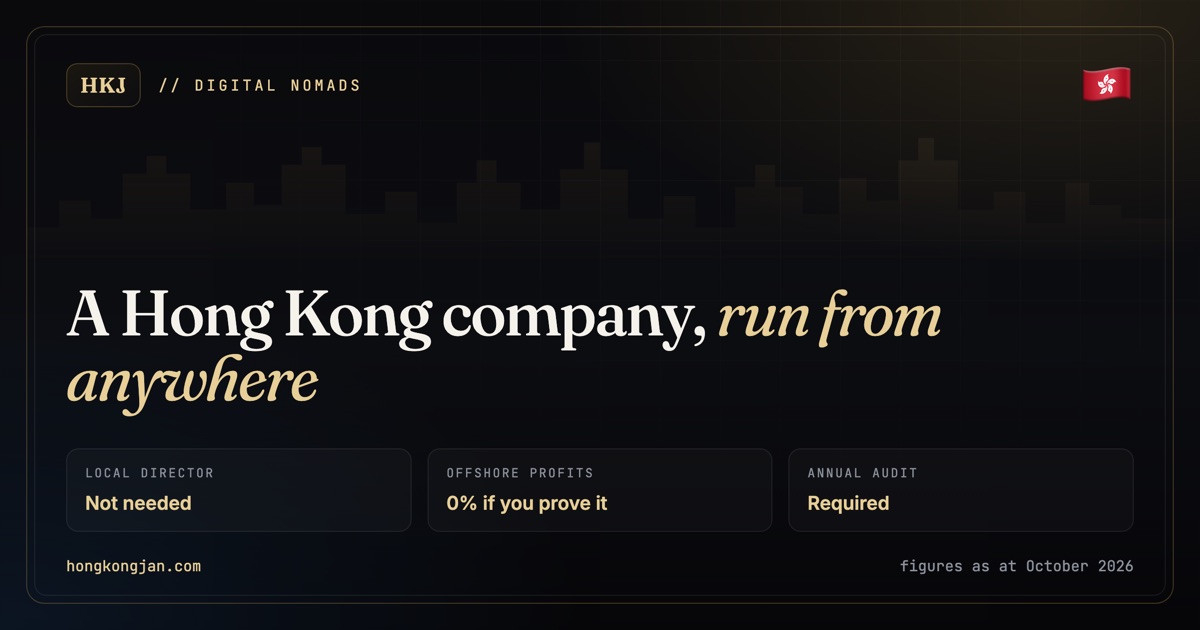
It's also one of the easiest places in the world to own a company from abroad. There's no local director requirement, so you can be the sole director and shareholder and live anywhere. You can register the whole thing remotely in one to three working days without ever flying in. You do need a Hong Kong company secretary and a Hong Kong registered address, but those are standard services.
So far, so good. Now for the detail.
The offshore claim when you have no fixed base
For a service business, the Inland Revenue Department's own guidance says the source of service fee income is the place where the services that earn the fees are performed. The broad principle the courts use is to look at what the company did to earn the profit and where it did it.
If you're a designer, developer or consultant doing all the work from a laptop outside Hong Kong, that points away from Hong Kong. That's the basis of an offshore claim, and for a genuine nomad the facts can support it well.
Three things people get wrong, though.
- It isn't automatic. You claim it in the profits tax return, with a computation showing why the profits aren't Hong Kong sourced. The company still files every year.
- You have to prove it. Expect the IRD to ask where you were, who did the work, where contracts were negotiated and signed, and how clients found you. Keep travel records, passport stamps, signed contracts and correspondence as you go.
- Hong Kong activity counts against you. If you spend months a year in Hong Kong, meet clients here or run the business from here, part or all of the profit can be Hong Kong sourced. Services performed partly here and partly abroad can be apportioned.
On the passive side, Hong Kong's foreign-sourced income exemption (FSIE) regime deems certain foreign dividends, interest, IP income and disposal gains received in Hong Kong to be taxable, unless an exception applies. It only applies to entities in a multinational group, meaning a group with at least one entity or permanent establishment outside the parent's jurisdiction. A one-person service company with no overseas subsidiary or branch usually sits outside it, but if you hold investments through the company, check.
The trap: you're taxed where you live
This is the bit that matters most. If the IRD accepts that the company's profits are offshore, those profits weren't earned nowhere. They were earned where you were sitting. And your personal tax position is decided by the country that treats you as a tax resident, not by Hong Kong.
A few things follow from that.
- Dividends and salary. Hong Kong doesn't tax dividends, but your country of residence probably does. Director's fees from a Hong Kong company can fall into Hong Kong salaries tax too, so how you pay yourself needs thought. My salaries tax guide covers the Hong Kong side.
- CFC rules. Many countries have controlled foreign company rules that tax you on a low-taxed foreign company's profits even if you leave them in the company. Every EU member state has had to adopt them, and the UK, Australia and Japan have their own versions. A Hong Kong company paying zero tax on offshore profits is exactly what those rules are built to catch.
- Citizenship-based tax. US citizens are taxed by the US wherever they live. A Hong Kong company doesn't change that, and it adds US reporting on top.
"I left my home country" isn't the same as "I'm no longer tax resident there". Each country has its own exit rules, and some keep you on the hook for years. Get advice in your home country before you rely on having left.
Permanent establishment and where the company is managed
There's a second risk, and it's on the company rather than on you. If you run the business from one place for long enough, that country may say your Hong Kong company has a permanent establishment there, or even that it's tax resident there because that's where it's really managed and controlled.
Spending three months a year in each of four countries is very different from spending eleven months a year in a Bali villa. The second pattern gives the local tax authority a much stronger argument. The thresholds and tests vary by country and by tax treaty, and Hong Kong only has treaties with some of them.
I'm not going to pretend there's a neat rule here. If you've settled somewhere, even informally, get a local tax opinion on whether the company is exposed there.
Banking, CRS and the no-fixed-address problem
Banks and payment platforms in Hong Kong take part in the Common Reporting Standard. They ask account holders, and the people who control company accounts, to certify where they're tax resident. Then they report the account details to the IRD, which passes them on to the tax authority of that country. So a Hong Kong account isn't invisible to your home country. It's designed to be visible.
The bigger practical problem for perpetual travellers is the reverse. Banks want a residential address with a recent utility bill or bank statement, and a country of tax residence to put on the form. "Nowhere in particular" doesn't fit their systems, and it reads as a risk flag to a compliance officer. The same issue is creeping into visas too. Since 31 August 2026, Thailand's DTV asks for proof of permanent residence where you apply.
In practice most of my nomad clients start with a digital account. Airwallex, Wise Business and Statrys can onboard remotely in days, as long as the paperwork is in order. I've no commercial relationship with any of them, so take that as an observation. A traditional bank account is possible but slower, and my non-resident banking guide explains why.
What it costs to keep running
Nomads often budget for the setup and forget the annual bill. Every Hong Kong company needs an audit every year, with no exemption for being small, and an offshore claim adds work to the tax filing.
| Item | Typical annual cost | Notes |
|---|---|---|
| Company secretary | HKD 2,000 to 5,000 | Required by law |
| Registered address | HKD 1,000 to 3,000 | Must be in Hong Kong |
| Accounting | HKD 5,000 to 15,000 | Depends on transaction volume |
| Statutory audit | HKD 5,000 to 15,000 | Mandatory for every company |
| Profits tax return | HKD 2,000 to 5,000 | More if you make an offshore claim |
| Offshore claim support | Varies | Extra if the IRD sends enquiry letters |
A small company usually runs HKD 20,000 to 45,000 in year one, including government fees. If your profit is modest, that's a real slice of it. Below roughly USD 50,000 a year in profit, the company often costs more than it saves.
Who it suits and who it doesn't
| Usually a good fit | Usually a poor fit |
|---|---|
| You have a clear tax residence somewhere that taxes you sensibly | You're hoping to be tax resident nowhere |
| Your clients are international and pay in USD, EUR or HKD | Your clients are all in one country where you live |
| Profits are big enough to absorb HKD 20,000 to 45,000 a year in compliance | You earn a modest freelance income |
| You want a credible, neutral company for contracts and invoicing | You need a local company to sponsor your own visa |
| You may sell into Greater China later | You're a US citizen expecting tax savings |
The founders who do well with it treat Hong Kong as a clean, well-regarded place to hold the business, and treat their personal tax as a separate question they answer properly.
So should you do it
If you're earning decent profit from clients around the world, and you're tax resident somewhere you've actually checked, a Hong Kong company is a solid choice. It's easy to own from anywhere, it's respected by clients and platforms, and if you genuinely work outside Hong Kong the offshore claim is a real benefit to the company.
If the plan is to use it so that nobody taxes you, I'd talk you out of it. CRS reporting, CFC rules and bank compliance all point the other way, and the cleanup costs far more than the tax.
I can set up and run the Hong Kong company, the audit, the tax filing and the offshore claim. For your personal tax, you'll want an adviser in the country where you're resident. If you'd like to talk through your own setup, book a free fifteen-minute call and I'll tell you honestly whether it makes sense.
Common questions
Is a Hong Kong company tax-free for digital nomads?
No. Profits not sourced in Hong Kong can be exempt from Hong Kong profits tax if you claim and prove it. But you're still taxed personally where you're resident, and your home country may tax the company's profits under CFC rules.
Do I need to live in Hong Kong or have a local director?
No. Hong Kong has no local director requirement. You need a Hong Kong company secretary and registered address, and both are standard services.
Will my home country find out about my Hong Kong bank account?
Very likely. Hong Kong banks and payment platforms report account details under the Common Reporting Standard to the tax authority of the country where you're tax resident.
Can I still get an offshore claim if I travel constantly?
Often yes, for service income performed outside Hong Kong. You have to make the claim in the tax return and back it with evidence of where the work was done.
Does my company still need an audit if it pays no Hong Kong tax?
Yes. Every Hong Kong company needs audited accounts every year, whether or not its profits are offshore.
What if I don't have a tax residence anywhere?
That's the hardest case. Banks expect a residential address and a country of tax residence, and many countries have rules that keep you resident until you clearly establish yourself elsewhere. Get advice before relying on it.