Vietnam comes up in almost every conversation I have with manufacturers and sourcing businesses now. Factories are moving there, the workforce is young, and the government clearly wants foreign investment. So people ask me, should I set up in Hong Kong or in Vietnam?
For most foreign founders, that's the wrong way round. The two do different jobs. I incorporate in both, so here's how I'd think it through.
Different jobs, not rival options
Vietnam is where you go when you need to be physically there. A factory, a warehouse, a development team, a sales office selling to Vietnamese customers. You can't do any of that through a Hong Kong company. You need a Vietnamese entity, a Vietnamese address and staff on Vietnamese payroll.
Hong Kong is where you go for the parts of the business that don't need to sit anywhere in particular. Holding shares, signing contracts with overseas customers, collecting money in US dollars, bringing in investors. It's quick to set up, you can own 100% of it with no licence for ordinary business, and it has no VAT, no capital gains tax and no dividend tax.
So the real question usually isn't Hong Kong or Vietnam. It's what each one should hold.
How a foreign-owned Vietnam company gets set up
A Hong Kong company takes a few working days, online. A foreign-owned Vietnam company is a licensing process.
The traditional route has two steps. First an Investment Registration Certificate, which approves your project. Then an Enterprise Registration Certificate, which creates the company. That route still exists. But the new Law on Investment, in force since 1 March 2026, also lets foreign investors set up the company first and get the Investment Registration Certificate within 12 months afterwards, provided the business is open to foreign investors. Until that certificate is issued, the company can't actually carry out the project, so the shortcut has limits.
After the certificates come the practical steps. A company seal, tax registration, and a direct investment capital account at a Vietnamese bank, which is the account your capital has to come in through. Then you generally have 90 days from the Enterprise Registration Certificate to pay the capital in.
In practice a straightforward setup takes something like one to two months. Conditional sectors, anything that needs its own sub-licence, take longer. And every round of questions from the licensing office adds a week or two.
Capital: no minimum on paper
For most businesses, Vietnam has no general minimum capital. That surprises people, and it's true, but it's only half the story.
The licensing office looks at whether your capital makes sense for the project you've described. Some sectors have their own legal minimums, with real estate the usual example. Your capital also matters later, for work permits and for how your bank sees you. So register a realistic number, not the smallest one you can get away with, and make sure you can actually pay it in on time. Miss the deadline and you're looking at fines and paperwork to cut your registered capital down to what you really paid.
Tax, side by side
| Hong Kong | Vietnam | |
|---|---|---|
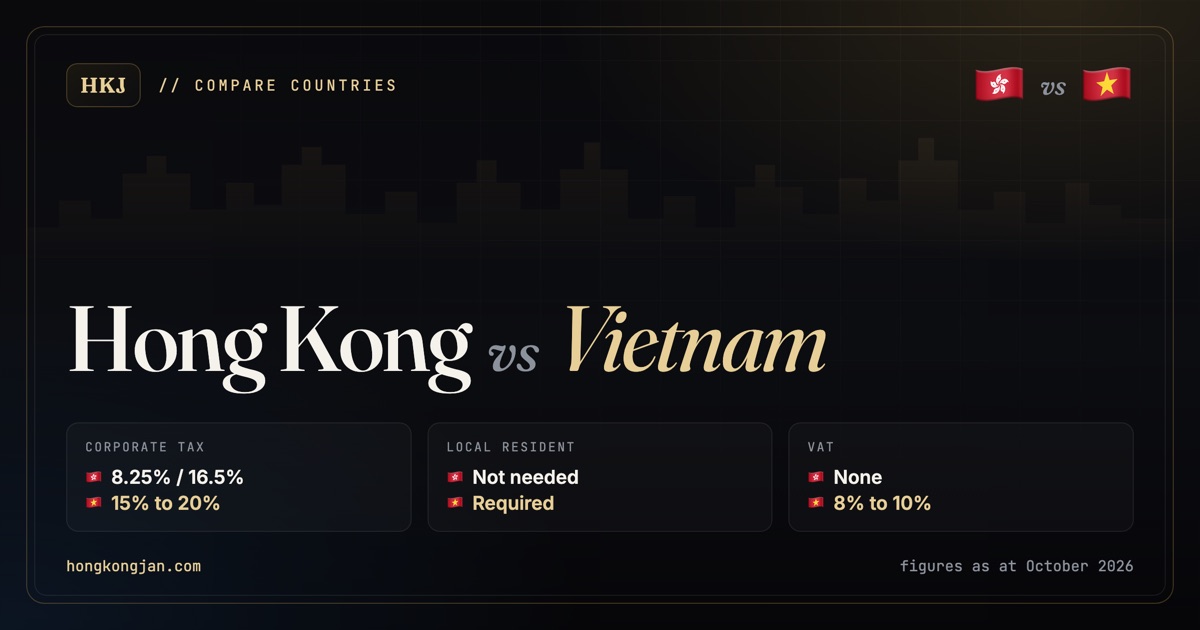
| Corporate tax | 8.25% on first HKD 2m, 16.5% above | 20% standard |
| Small company rates | The two-tier rate above applies to everyone | 15% if revenue is up to VND 3 billion, 17% up to VND 50 billion |
| VAT | None | 10% standard, cut to 8% for many goods and services until 31 December 2026 |
| Tax on dividends paid to a foreign company | None | None |
| Paying overseas suppliers | No withholding on ordinary service fees | Foreign contractor tax withheld |
| Annual audit | Required for every company | Required for every foreign-invested company |
| Local resident needed | No | At least one legal representative living in Vietnam |
| Time to set up | A few working days | Roughly one to two months |
Vietnam's new Corporate Income Tax Law, Law No. 67/2025/QH15, took effect on 1 October 2025 and applies from the 2025 tax year. It kept the standard rate at 20% but added lower rates for smaller companies: 15% where annual revenue is up to VND 3 billion, and 17% up to VND 50 billion. They don't apply if your small company belongs to a group that's too big to count as a small or medium enterprise. Vietnam also stopped charging its annual business licence fee from 1 January 2026, which is a small but welcome change.
On VAT, the standard rate is 10%. A temporary cut to 8% covers many goods and services from 1 July 2025 to 31 December 2026, but not telecoms, banking, finance, insurance, real estate, or some metals and mining. As I write this in October 2026, no extension beyond the end of the year has been announced, so plan on 10% from January unless that changes.
The rules that catch foreign founders
- Someone has to live there. A Vietnamese company needs at least one legal representative who lives in Vietnam. If the only one is out of the country for more than 30 days without authorising someone else, the company has a problem. If you aren't moving, you need a trusted local person in that role, and that person carries real legal responsibility.
- Every year is audited. All foreign-invested companies need audited financial statements every year, regardless of size, due by the end of the third month after the year end. Hong Kong is the same, so no surprise there.
- Getting profit out has conditions. You can send profit abroad once the year's tax is settled, the audited accounts and corporate tax return are filed, and the company has no accumulated losses. You notify the tax office at least seven working days before the transfer, and the money goes out through the capital account. In practice that means once a year after the year end, not whenever you like. The good news is that Vietnam doesn't withhold tax on dividends paid to a foreign company.
- Foreign contractor tax. When your Vietnam company pays a foreign supplier, including your own Hong Kong company, it usually has to withhold tax from the payment. For ordinary services that's typically a few percent of VAT plus a few percent of corporate tax, often 5% each, with different rates for royalties and interest. The Hong Kong and Vietnam tax treaty can reduce or remove the corporate tax part, but you have to claim it.
Hong Kong on top, Vietnam underneath
This is the structure I set up most often for clients with operations in Vietnam. A Hong Kong company owns the Vietnamese company. Hong Kong holds the shares, deals with overseas customers and investors, and banks internationally. Vietnam does the work on the ground. It's the same idea as using Hong Kong as a holding company for Greater China.
Why it works:
- Dividends travel cleanly. No Vietnamese withholding tax on dividends to a foreign company, and Hong Kong doesn't tax dividends in ordinary cases. Under Hong Kong's foreign-sourced income rules, overseas dividends can be taxed unless an exemption applies. For a normally taxed Vietnam subsidiary the participation exemption usually covers it, but check how the rules apply to you.
- Investors understand it. Bringing in a partner or raising money is far simpler at the Hong Kong level, where shares are easy to transfer. Vietnam may still have a say in how a sale is taxed, so take advice before you sell.
- It can be the trading layer. The Hong Kong company can buy from the Vietnam factory and sell to customers abroad. Just remember the prices between the two have to be arm's length and documented. Vietnam has transfer pricing rules and it does check.
Two companies means two sets of compliance. Both need audits and both need tax returns. It's worth it when Vietnam is a genuine operation. It isn't worth it for a one-person consultancy.
So which one
If you need staff, premises, a factory or Vietnamese customers, you need a Vietnamese company. No Hong Kong structure replaces that. If your business is international and nobody needs to be on the ground in Vietnam, Hong Kong is faster, simpler, and has no foreign ownership licensing at all.
And if you're doing both, put Hong Kong on top as the holding and trading company and Vietnam underneath as the operating company. For most founders building something real in Vietnam, that's what I'd recommend.
I incorporate in both Hong Kong and Vietnam, so I can look at the whole structure rather than one half of it. If you'd like a second opinion on yours, book a free fifteen-minute call.
Common questions
Can a foreigner own 100% of a Vietnamese company?
Yes, in many sectors. Some business lines are restricted or come with conditions for foreign investors, so check the market access rules for your activity before you apply.
How long does it take to set up a company in Vietnam?
Roughly one to two months for a straightforward foreign-owned company, including the bank account and seal. Conditional sectors take longer. A Hong Kong company takes a few working days.
What's the corporate tax rate in Vietnam?
20% as standard. Under the new CIT law, smaller companies pay 15% if revenue is up to VND 3 billion and 17% if it's up to VND 50 billion, from the 2025 tax year.
Is Vietnam's VAT 8% or 10%?
The standard rate is 10%. Many goods and services get a temporary 8% rate until 31 December 2026, with exclusions such as telecoms, finance, insurance and real estate.
Do I have to live in Vietnam to run a Vietnamese company?
You don't, but someone does. The company needs at least one legal representative who lives in Vietnam. Hong Kong has no residency requirement for directors.
Is there a double tax agreement between Hong Kong and Vietnam?
Yes. It was signed in December 2008 and has been in force since 2009. It can reduce Vietnamese tax on payments like royalties and service fees to a Hong Kong company, if you claim it.
Can you set up both companies?
Yes. I incorporate in both Hong Kong and Vietnam, so I can set up the holding company and the subsidiary together and keep the paperwork consistent.