Hong Kong or Dubai comes up a lot with founders who could live almost anywhere. Both have low tax, both are international hubs, and both are a long way from the founder's home tax office. That's where the similarity mostly ends.
One thing up front. I set up and run Hong Kong companies. I don't set up companies in the UAE, and I don't file UAE tax returns or arrange UAE visas. If Dubai is the right answer for you, use a licensed UAE adviser for that side. I'll tell you honestly where Dubai wins.
The question that actually decides it
With Singapore, the deciding question is where your customers are. With Dubai, it's a different one. Are you actually going to move there?
Dubai's biggest advantage isn't the company. It's the person. The UAE has no personal income tax, and it will give you a residence visa through your own company. If you relocate, live there properly and stop being tax resident at home, that's a real and legal way to pay very little tax on what you earn.
If you're not moving, most of that advantage disappears. A UAE company run from London, Sydney or Berlin doesn't make you tax free. Your home country will usually still tax you, and it may argue the company itself is managed from there. At that point you're comparing two corporate tax systems, and Hong Kong holds up very well.
Corporate tax, side by side
| Hong Kong | UAE | |
|---|---|---|
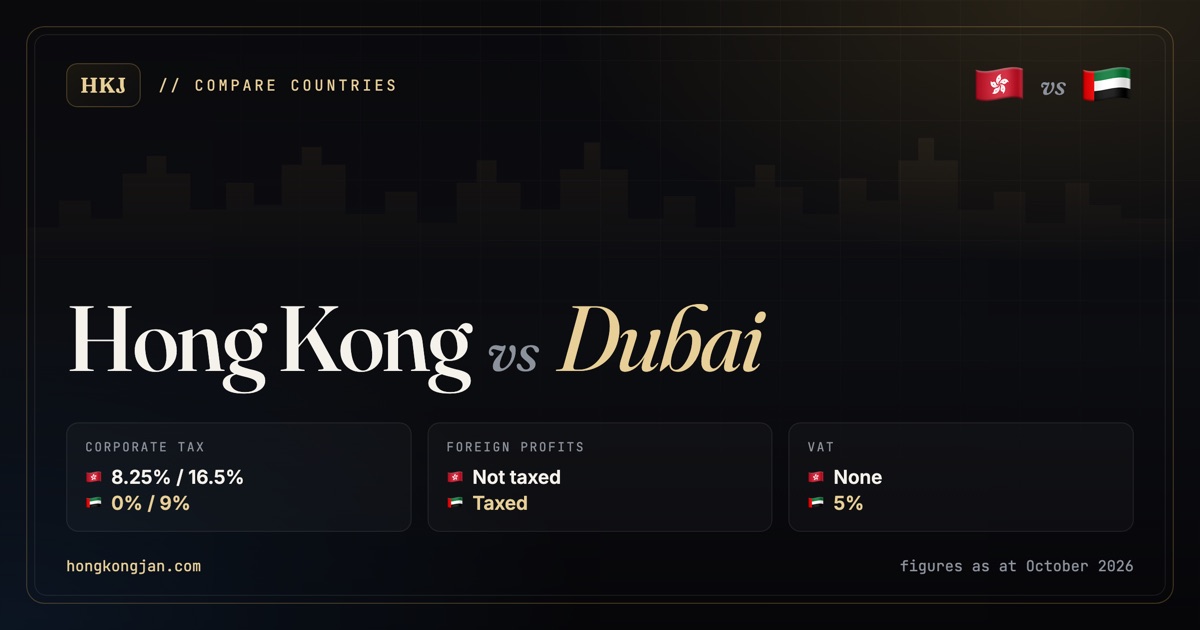
| Corporate tax | 8.25% on first HKD 2m, 16.5% above | 0% up to AED 375,000, 9% above |
| Small company relief | None, the two-tier rate applies to everyone | Small Business Relief if revenue is AED 3m or less, for tax periods ending by 31 Dec 2029 |
| Free zone regime | Not applicable | 0% on qualifying income if you meet the conditions |
| VAT or GST | None | 5% VAT, registration above AED 375,000 |
| Personal income tax | Salaries tax on Hong Kong employment | None |
| Foreign-sourced profits | Not taxed if genuinely offshore | Taxed, UAE companies are taxed on worldwide income |
| Tax treaty with each other | Yes, in force since December 2015 | Yes, the same agreement |
The UAE introduced federal corporate tax for financial years starting on or after 1 June 2023. Profit up to AED 375,000 is taxed at 0% and everything above at 9%. That's a lower headline rate than Hong Kong's 16.5%, but higher than our 8.25% on the first HKD 2 million.
Small Business Relief lets a company with revenue of AED 3 million or less elect to be treated as having no taxable income. It was originally due to end with tax periods ending on 31 December 2026. In August 2026 the Ministry of Finance extended it to tax periods ending on or before 31 December 2029, with the AED 3 million threshold unchanged. You have to elect for it in your return, and it isn't available to Qualifying Free Zone Persons or members of large multinational groups.
From 2025 the UAE also applies a 15% domestic minimum top-up tax to multinational groups with global revenue of EUR 750 million or more. If you're reading this as a founder, that won't be you.
Hong Kong is territorial. Profits that genuinely arise outside Hong Kong aren't taxed here, though you have to prove it with an offshore claim. The UAE taxes a resident company on worldwide income instead.
Free zone or mainland
This choice doesn't exist in Hong Kong, so it trips people up.
A mainland company is licensed by the emirate and can trade anywhere in the UAE. Most activities now allow 100% foreign ownership, but you'll usually need a physical office lease, and it costs more to run.
A free zone company is licensed by one of the free zone authorities. It's quicker and cheaper, often with a flexi-desk instead of a real office. The trade-off is that it's mainly meant to do business inside the free zone and abroad, not with mainland UAE customers.
The famous 0% rate belongs to the free zone side, and it isn't automatic. To be a Qualifying Free Zone Person, a company has to earn qualifying income, keep non-qualifying revenue below the lower of 5% of total revenue or AED 5 million, have adequate substance in the UAE, follow transfer pricing rules, and prepare audited financial statements. Fail a condition and you're taxed at 9% for that year and the following four.
A quick word on economic substance. The UAE's standalone economic substance regulations were scrapped for financial years ending after 31 December 2022. But the free zone regime has its own substance test, so a licence and a flexi-desk with nobody doing anything there won't get you 0%.
Personal tax, visas and residency
In the UAE, your company can sponsor a residence visa for you. You'll go through a medical test and biometrics, then get an Emirates ID. That visa is what lets you live there, open personal accounts and sign a lease.
A visa on its own doesn't make you UAE tax resident. Since March 2023, an individual is UAE tax resident if their usual residence and centre of financial and personal interests are in the UAE, or they spend 183 days there in a 12-month period, or they spend 90 days there while holding a UAE residence permit and having a permanent home or business there. You can then apply for a tax residency certificate, which you'll want if your old country ever asks questions.
Hong Kong works differently. A Hong Kong company doesn't give you a right to live here. If you do live here and work for your company, you pay salaries tax at progressive rates up to 17%, or the standard rate of 15% (16% on the part above HKD 5 million) if that's lower. Dividends aren't taxed. If you live elsewhere and run the company from there, Hong Kong generally won't tax your personal income, but your home country probably will.
What it costs to set up and keep running
| Cost | Hong Kong | Dubai free zone |
|---|---|---|
| Licence or government fees | Small, a few thousand HKD | Roughly AED 12,500 to 20,000 a year for a basic licence |
| Residence visa | Not included, separate application | Typically AED 3,000 to 7,000 per person, plus Emirates ID and medical |
| Office | Registered address HKD 1,000 to 3,000 | Flexi-desk often bundled, a real office extra |
| Accounting and tax filing | HKD 7,000 to 20,000 | AED 5,000 to 15,000, depending on volume |
| Audit | Required every year, HKD 5,000 to 15,000 | Required for free zone 0% status, revenue over AED 50m, and by many free zones at renewal |
| Typical year one total | HKD 20,000 to 45,000 | AED 18,000 to 35,000 |
The Dubai figures are typical market ranges and they move a lot by free zone, activity and number of visas, so get a current quote. The bigger point is that a UAE licence is renewed every year, and you pay most of the licence fee again each time. A Hong Kong company has no licence to renew, just the annual Business Registration and annual return.
Every UAE company also has to register for corporate tax, even if it expects to pay nothing, and file a return within nine months of its year end. Miss the registration deadline and the standard penalty is AED 10,000.
Banking is hard in both
Neither is easy, and anyone who says otherwise hasn't opened an account lately.
UAE banks do heavy due diligence, often want to see a UAE resident visa, and some ask for minimum balances. Companies from the cheaper free zones with no visible activity can find it especially slow. Hong Kong banks have also tightened a lot for foreign-owned companies, and months of review isn't unusual. I've written about that in detail in opening a Hong Kong business bank account as a non-resident.
In both places, digital business accounts get you trading while a traditional bank decides. I've no commercial relationship with any of them.
Could you use both?
Some people do, usually a founder living in Dubai with a Hong Kong company for Asian suppliers and customers. Hong Kong and the UAE have a comprehensive double tax agreement, in force since December 2015, which helps when money moves between them.
The catch is where the Hong Kong company is managed from. If you live in Dubai and run everything from there, you need advice on whether the UAE sees the Hong Kong company as UAE tax resident. Get that looked at on both sides before you build it.
So which one
Pick Dubai if you'll genuinely move there, want 0% personal income tax and a residence visa, and your business doesn't depend on being close to China. It's a strong choice for that person, and I'd say so to their face.
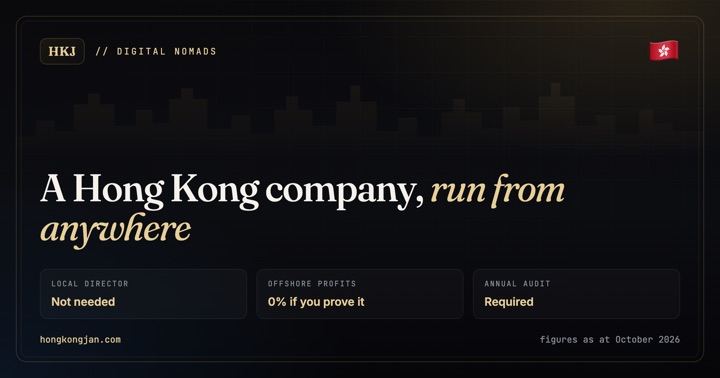
Pick Hong Kong if your business faces Asia and especially China, you don't want to relocate, and you'd rather have a simple company with a low effective rate, no VAT, no licence renewal and no visa admin. You can run it from anywhere.
If you're still torn, book a free fifteen-minute call. I'll tell you honestly if Hong Kong doesn't suit you, and I'll set up the Hong Kong side properly if it does.
Common questions
Is Dubai really tax free?
Not for companies any more. Since June 2023 UAE companies pay 9% on profit above AED 375,000, unless they qualify for Small Business Relief or the free zone 0% rate. There's still no personal income tax.
Can I keep living at home and use a Dubai company to avoid tax?
Usually not. Your home country will typically tax you, and may treat the company as managed from there. The personal tax benefit only works if you genuinely move and become UAE tax resident.
How long does UAE Small Business Relief last?
It now covers tax periods ending on or before 31 December 2029, after an August 2026 extension. Revenue must be AED 3 million or less and you have to elect for it.
Does a Hong Kong company give me the right to live in Hong Kong?
No. Owning a company doesn't come with residency. You'd need a separate visa, and many owners run their Hong Kong company from abroad.
Is an audit required in both?
Hong Kong, yes, for every company every year. In the UAE it depends: free zone companies claiming 0%, companies with revenue over AED 50 million, and many free zones at licence renewal.
Is there a tax treaty between Hong Kong and the UAE?
Yes. A comprehensive double tax agreement has been in force since December 2015.
Can you set up my Dubai company?
No. I only handle the Hong Kong side. For a UAE licence, visa or tax filing, use a licensed UAE adviser.